
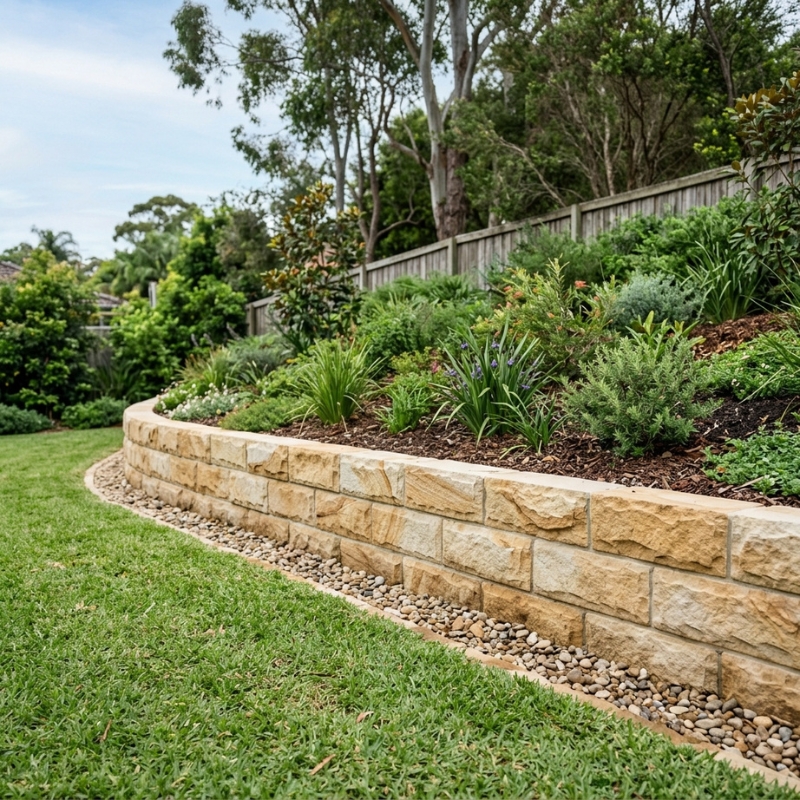
“How much does a retaining wall cost?” is one of the trickier questions in landscaping, because the same length of wall can carry very different price tags depending on what it has to do. If you have a sloping block, a failing old wall, or a project that needs level ground, understanding the cost drivers helps you budget sensibly before you start ringing around for quotes. This guide walks through what actually moves the price of a retaining wall in Sydney. All Green Gardening and Landscaping has built and repaired retaining walls across Sydney for more than eleven years, so these are the factors we weigh on every job.
| Quick answer: Retaining wall cost in Sydney is driven mainly by wall height, length, material such as timber, besser block, sandstone or concrete sleepers, the amount of excavation, and drainage requirements. Walls over about a metre often need engineering and council approval, which adds cost but is essential for safety in Sydney’s clay soils. A site visit gives the only accurate, fixed price. |
What a retaining wall actually has to do
It is easy to think of a retaining wall as a decorative feature, but its real job is structural. A retaining wall holds back soil and manages the pressure of the ground and the water within it, which is a serious load, especially on Sydney’s clay soils that swell and hold moisture. Good drainage behind the wall is just as important as the wall itself, because trapped water is what pushes walls over time. That is why cost varies so much: a low garden edge doing very little work is a modest job, while a taller wall holding back a slope and managing drainage is a proper engineering task. The higher the wall and the more it has to retain, the more it costs to build it safely.
The main cost drivers
Rather than look for a single number, it helps to understand the levers that push a retaining wall up or down in price. These are the ones that matter most:
- Height: taller walls carry far more load, so they need stronger construction and often engineering, which is a major cost driver.
- Length: the longer the wall, the more material and labour it takes.
- Material choice: timber, besser block, sandstone and concrete sleepers sit at different price points and lifespans.
- Excavation and access: digging into a slope and getting machinery to it adds time, and tight access makes it harder.
- Drainage: proper drainage behind the wall adds cost but is essential to stop it failing.
- Engineering: taller or load bearing walls need engineering input, which adds to the overall price.
Weigh your wall against these factors and you will quickly see why a quote is specific to your site rather than a rate per metre.
Material choices for Sydney conditions
The material you choose affects both the look of the wall and how long it lasts. Timber sleepers are often the most budget-friendly and suit a natural garden feel, though they have a shorter lifespan than masonry options. Besser block is strong, versatile and can be rendered or clad, making it a common choice for structural walls. Sandstone is a classic Sydney look that ages beautifully and holds real character, sitting at the premium end for both material and labour. Concrete sleepers, set between steel posts, are durable, clean-lined and popular for a modern finish. The right choice balances your budget, the look you want and how much work the wall has to do, since a structural wall on a steep block has different demands from a low garden terrace.
When approval and engineering are needed
Once a wall passes a certain height, it stops being a simple garden job and becomes a regulated one. As a general guide in NSW, walls over about a metre often need engineering and may require council approval, though the exact rules vary from council to council and by site conditions such as boundaries, drainage and how much the wall supports. Taller walls need engineering because they carry serious loads, and getting that right is what keeps them safe over the long term. Because these thresholds and requirements differ across local government areas, always confirm the rules for your specific site with your local council before you build. It is general guidance here, not a universal rule, and your council has the final say.
Repair, rebuild and getting a quote
Not every ageing wall needs replacing, and knowing the difference can save you a lot. Some walls can be reinforced or repaired, while others have gone too far and need rebuilding for safety. If your wall is leaning, cracking, bulging or shifting, it is worth reading our guide on retaining wall warning signs to understand which camp yours falls into before you spend a cent. Whether you need a fresh build or work on an existing wall, the honest price only appears after someone has assessed the site, the ground and the drainage. Our team handles retaining wall construction and repair across Sydney and quotes each job as a fixed price after a free site visit.
Frequently Asked Questions
How much does a retaining wall cost in Sydney?
There is no single figure, because height, length, material, excavation and drainage all change the price. A low timber garden wall and a tall engineered sandstone wall are very different jobs. The most accurate way to know your cost is a fixed-price quote after we have assessed the site, the slope and the drainage.
Is a sandstone retaining wall more expensive?
Usually yes. Sandstone tends to sit at the premium end for both the material and the labour involved, since it is heavier and requires skilled placement. Many homeowners choose it for its classic Sydney look and long life. Timber and besser block are often more budget-friendly alternatives depending on the job.
Do I need council approval for a retaining wall?
Possibly. As a general guide in NSW, walls over about a metre often need approval and engineering, but the rules vary by council and by factors like boundaries and drainage. Lower walls may not, in some cases. Always confirm the requirements for your specific site with your local council before you build.
Why does drainage add to the cost?
Drainage adds cost because it involves materials and work behind the wall, such as aggregate, drainage pipe and proper falls. It is not optional, though. Trapped water is one of the main reasons retaining walls fail over time, so building in good drainage from the start is what keeps the wall standing and protects your investment.
Building a wall that holds
Retaining wall cost in Sydney comes down to height, length, material, excavation and drainage, with engineering and approval adding to taller or load-bearing walls. Get the structure and drainage right and a good wall will hold ground back safely for decades. The best way to turn these factors into a firm number is to have us assess your site and quote the actual job. Book a free, fixed-price site visit with All Green Gardening and Landscaping, a licensed Sydney team with more than eleven years of experience and a 4.9-star rating from 52 reviews, and we will give you an accurate price and honest advice.