
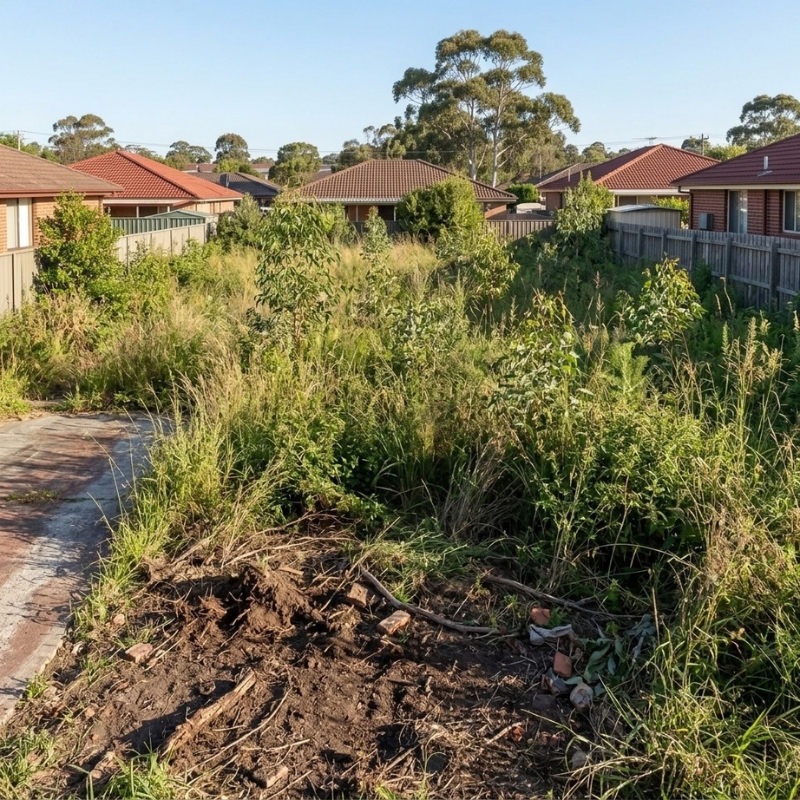
You are standing in front of a block that has got completely away from you. Waist-high growth, self-seeded saplings that have turned into young trees, and something dumped in the back corner that you cannot quite make out through the weeds. You have no idea where to start. Here is the honest shape of it: clearing a block is really three jobs, not one. There is cutting and removing the vegetation, dealing with whatever has been dumped or has collapsed on site, and leaving the ground in a state you can actually use. All Green clears overgrown blocks across Sydney, and this article gives you a clear picture of what happens, in what order, and the things that have to be checked before anyone fires up a brushcutter.
Clearing an overgrown Sydney block means removing the vegetation, taking out whatever has been dumped or has collapsed on site, and leaving the ground level enough to use. The order matters: access first, then vegetation, then debris, then the ground. What slows most jobs is not the growth, it is finding out partway through what is under it.
What has to be checked before anyone starts?
The checks before the work are where a clearing job is won or lost, so this is the part to get right first. Run through these questions before anyone starts cutting:
- Do any trees on the block need council approval to remove? Trees above your council’s size threshold usually cannot just be taken out, so this has to be confirmed rather than assumed.
- Are any trees protected or heritage-listed? Some vegetation is protected regardless of size, and clearing it without checking can land you in real trouble.
- Where do the services run? Water, gas, electricity, sewer and stormwater can all cross a block, and you do not want to find a line with a machine. This is exactly what Before You Dig is for, so you request the plans rather than guessing where things run.
- Does a neighbour’s fence, retaining wall or tree overhang the work? Anything on or over the boundary needs sorting before the work reaches it, not during.
- Is the block on a slope? Clearing growth off a slope changes how water moves across it, which can create runoff or erosion if it is not thought through first.
Answer those before the job starts and the clearing itself goes smoothly. Skip them and the job stops halfway while something gets untangled, which is the most common reason a straightforward clear turns into a drawn-out one.
The vegetation, and what actually happens to it?
With the checks done, the vegetation is cleared in stages rather than all at once. The first pass knocks the growth down to a workable height, so the crew can actually see the ground and what is on it. Then the woody material and self-seeded saplings are cut and removed, which is the slower part because established stems take more work than soft growth. Where the ground has to be reused, the root masses are grubbed out rather than left in, since roots left in place sprout again and get in the way of whatever comes next. Then the site is raked off to leave a clean surface.
What happens to all that material matters for the cost. Green waste is kept separate from general waste, because the two go to different places and are charged differently, so mixing them into one pile actually costs more to dispose of. Keeping the streams apart from the start is part of doing the job properly. Where the volume allows, the material leaves the site the same day rather than sitting in a heap waiting on a second trip.
Rubbish, debris and the things nobody mentions on the phone
Here is the part that catches people out: what is usually hiding under an overgrown block. Once the growth comes down, it is common to uncover dumped household waste, old fencing, broken concrete and pavers, a collapsed shed, stacks of tyres, and the sort of general rubbish that accumulates when a block has been left. None of that is visible when you are quoting over the phone, which is exactly why it causes problems if it is not planned for.
The one to be plain about is asbestos. Anything built before the 1990s can contain asbestos sheeting, and it turns up in old sheds, fencing and dumped building material more often than people expect. Asbestos is not removed as general rubbish. It is licensed work under NSW rules with its own strict disposal requirements, and it is never just loaded onto the truck with everything else. If it turns up, the work stops on that part of the site until it is handled properly by the right people. This is the main reason a clearing quote is staged rather than fixed: nobody can honestly price what is sitting under two metres of growth before they have seen it.
What does the ground look like when the clearing is done?
It is worth setting expectations honestly here, because a cleared block is not a finished block. When the growth and the debris are gone, what you are left with is bare earth, usually with some unevenness where root masses were grubbed out, and a surface that looks raw rather than landscaped. That is normal, and it is the correct result of a clearing job, not a half-done one.
There is also seed already sitting in the soil, and on a bare Sydney block that will start germinating within weeks in the warmer months. So the real question is what happens next, and there are two honest paths. If the block is not being used yet, a holding treatment keeps the regrowth down so it does not simply return to a jungle while it sits. If you are ready to use it, you go straight into the next stage, turf, paving or planting, before the weeds get a chance to take hold again. Either way, deciding the follow-on before the clearing finishes saves you clearing it twice.
How is a clearing job quoted and staged?
A clearing job is quoted in a way that reflects the uncertainty of what is under the growth, which protects you from a wild guess. It starts with a site visit, because that is the only way to size the job accurately. From there you get a fixed price for the vegetation and the debris that can actually be seen, and a stated rate or a re-quote for anything uncovered once the growth is down, such as buried rubbish or material that needs special handling.
Access is the big variable that moves the price. Whether a truck can reach the block or everything has to be barrowed out to the street makes a real difference, as does whether a machine can get in or the work has to be done by hand. Whether material can be stockpiled on site for one removal, or has to go straight out as it is cut, changes the job too. All of this is why All Green quotes after a look at the site rather than over the phone, since an accurate price depends on seeing what is actually there.
Frequently Asked Questions
Do I need council approval to clear a block?
You may, and it depends on what is on it. Removing trees above your council’s size threshold usually needs approval, and some vegetation is protected regardless of size. Grass, weeds and small shrubs generally are not. Tell us the address and we will tell you what applies before quoting.
What happens if asbestos turns up under the growth?
Work stops on that part of the site. Asbestos removal in NSW is licensed work with its own disposal rules, and it is never taken away as general rubbish. We will tell you what we have found and what has to happen before the clearing can continue safely.
Will the weeds just come straight back?
Some will. Clearing removes what is growing, not the seed already in the soil, and a bare Sydney block will show new growth within a few weeks in the warmer months. That is why the plan for what happens next matters as much as the clearing itself does.
Clearing the block, and getting it right
The clearing itself is the straightforward part. It is the checks beforehand and the plan afterwards that decide whether the whole thing goes smoothly or turns into a saga. Sort out the approvals, the services and the boundaries first, clear in the right order, then have a plan for the bare ground before the crew leaves. If you have a block that has got away from you, book a site visit and we will tell you what is involved, what needs checking first and what land clearing and rubbish removal in Sydney will cost before anyone starts. That way there are no surprises halfway through, and you know exactly what you are dealing with from the outset.