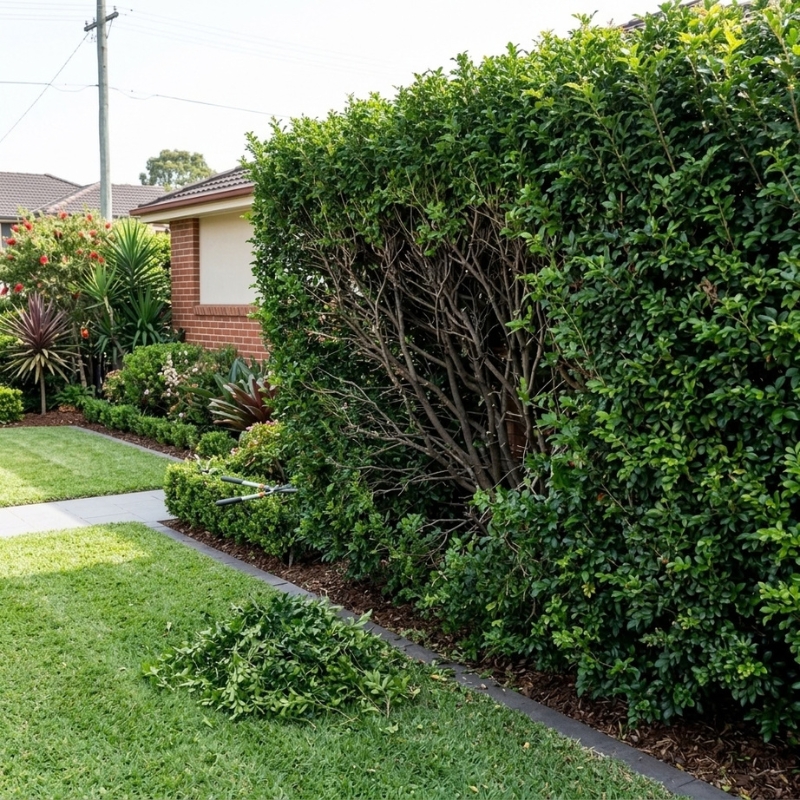
You are looking at a hedge that has got away from you. It is now close to twice as wide as it should be, bare and twiggy on the inside, and green only on the thin outer shell. The obvious question is whether you can cut it back hard and bring it back, or whether you have left it too long. Here is the honest answer: most hedges can be restored, but whether you can do it in one cut depends entirely on the species, because some reshoot happily from bare wood and some never will. All Green restores overgrown hedges across Sydney, and this article gives you a clear answer for your hedge before anyone takes the shears to it.
Most overgrown hedges can be restored, but not all in one cut. Species that reshoot from old wood, lilly pilly, murraya, photinia and buxus among them, take a hard cut back and recover. Conifers such as leyland cypress and most junipers will not reshoot from bare brown wood, so cutting into it leaves a permanent hole.
First, what is the hedge?
Species is the entire decision here, so before anything else you need to know what you are working with. Hedges split into two groups, and which one yours falls into decides whether a hard cut-back is a restoration or a mistake.
The first group reshoots from old wood. This covers lilly pilly, murraya, photinia, buxus, escallonia, viburnum and most of the broadleaf evergreens common in Sydney gardens. These can be cut back hard, right into the bare inner wood, and they will push fresh new growth from it. For this group, an overgrown hedge is a recoverable one.
The second group will not reshoot from bare brown wood. This is leyland cypress, most conifers, juniper, and some rosemary hedges. On these, the green outer shell is all the growth you have, and if you cut past it into the brown, that brown stays brown and the gap is permanent. There is a simple check you can do yourself: look along the inner wood for small dormant buds, or scratch a little bark off an inner stem and look for green underneath. Green and buds mean life and a chance of reshooting. Dry brown wood with nothing dormant means what you cut is what you keep.
Why do hedges go bare in the middle?
A hedge goes hollow for a reason, and understanding it explains both the fix and how to avoid a repeat. When a hedge is trimmed to the same line year after year, it keeps thickening on the outside, and that dense outer shell gradually shades the interior. The inner growth, starved of light, simply dies off, which is why an old hedge is green on the surface and bare twigs within.
There is a second cause worth knowing, because it is the one most people get wrong. A hedge cut square, or wider at the top than the bottom, shades its own base, which is exactly why the bottom of a hedge thins out first. The fix is the single most useful idea in hedge care: the batter. A hedge should be cut slightly wider at the base than at the top, so the whole face is angled to catch the light and the lower growth is not left in the shade of the upper. Get the batter right and a hedge stays full from top to bottom instead of going bare and leggy underneath.
How is a hard cut-back staged?
On a species that reshoots, the worst thing you can do is take the whole hedge back to bare wood in one go, so a restoration is staged instead. The approach is to cut one face back hard, let it reshoot over a growing season, and then do the second face and the top once the first has recovered. The reason is energy: a hedge draws on its reserves to push new growth, and stripping everything at once leaves it weakened, slow and patchy to come back. Leaving one face full keeps the plant fed while the cut face regenerates.
Timing matters in Sydney. The main cut-back goes in from early spring, once the frost risk has passed, so the plant has the whole warm growing season ahead of it to respond. A follow-up trim then comes in late summer to shape the new growth. It is worth knowing what the hedge looks like in between, because it is not pretty: the cut face will be bare and twiggy for several months before it greens up. That is completely normal and not a sign anything has gone wrong, it is simply what a recovering hedge looks like while it does the work.
When does replacing beat restoring?
Restoration is not always the right answer, and it is worth being honest about when replanting is the better call. A non-reshooting conifer that has gone bare inside is the clearest case, because cutting it back only exposes brown that will never green up. A hedge with large gaps where whole plants have died is another, since there is nothing left to reshoot in those sections. So is a hedge planted too close to a wall, a fence or a boundary, where it will always be a problem no matter how well it is cut. And a hedge that has outgrown its space so badly that even the restored size will not fit is one to rethink rather than persevere with.
Replanting does mean living with a smaller hedge for two to three years while it establishes, but you end up with a correct one afterwards rather than fighting the same problem forever. If losing the screen entirely is the concern, a staged replacement, taking out and replanting a section at a time, keeps most of the screen in place while the new plants come on.
How do you keep it right once it is back?
Bringing a hedge back is wasted effort if it just goes hollow again, so the maintenance afterwards is what makes it last. Three habits do most of the work. Trim to a batter every time, keeping the base wider than the top so light reaches the whole face and the bottom never thins out. Cut on a rhythm rather than waiting until the hedge looks overgrown, which for most Sydney hedges means two to three times a year. And take a fraction more off each time than last year’s line, so the hedge holds its shape instead of creeping outward season by season until you are back where you started.
One honest practical note: a restoration cut produces far more green waste than a routine trim, often several times the volume, and all of it has to leave the site. It is worth factoring in that the clean-up from a hard cut-back is a bigger job than a maintenance tidy, both in material and in the removal.
Frequently Asked Questions
Will cutting my hedge back hard kill it?
It depends entirely on the species. Lilly pilly, murraya, photinia and buxus reshoot from old wood and recover well from a hard cut. Conifers such as leyland cypress generally will not reshoot from bare brown wood, so cutting into it leaves a gap that stays bare.
How long before a cut-back hedge looks good again?
Expect a full growing season for the first face to green up, and around two seasons before a staged restoration looks like a proper hedge again. It looks worse before it looks better, which is the part most people are not warned about beforehand.
When is the best time to cut a hedge back hard in Sydney?
Early spring, once the cold has passed, so the plant has the whole warm season to put on new growth. A hard cut going into winter leaves the hedge bare and slow for months, with nothing to recover with until the weather warms up again.
Bringing your hedge back the right way
It comes down to three steps. Work out what species the hedge is, because that decides whether it can come back at all. Stage the cut over two seasons rather than scalping it in one. And where the species simply will not reshoot, replace rather than restore instead of chasing a recovery that cannot happen. If you are not sure what your hedge is or whether it will come back, book a site visit and we will tell you straight before anything is cut, hedge trimming services in Sydney. That way you know whether you are looking at a recoverable hedge or a replanting job before a single branch comes off.