Healthy, well-shaped trees can lift a front yard, reduce summer power bills and add thousands of dollars to resale prices. But reach for the chainsaw without a plan and the opposite can happen just as fast. In Penrith and the wider Sydney basin, two words cause no end of confusion: lopping and pruning. They sound similar, yet the techniques, outcomes and legal implications could not be further apart. Before you book a contractor or tackle the branches yourself, it pays to understand how the two approaches diverge, what your local council expects and when calling in professional tree services in Penrith is the safer play.
What’s the Real Difference Between Lopping and Pruning?
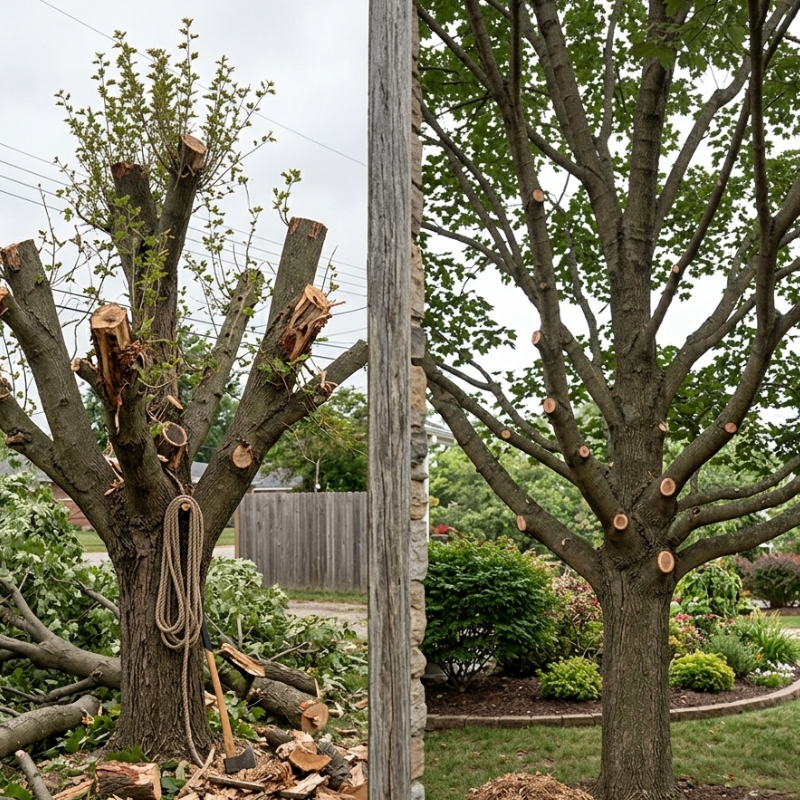
Tree lopping is the practice of cutting back large sections of the canopy or even the main trunk to reduce height quickly. Little thought is given to natural growth points, future branch structure or sap flow. Pruning, on the other hand, is a selective cut made at the right spot—usually just outside the branch collar—to guide healthy growth, remove hazards and support the tree’s long-term form.
Why the Distinction Matters
- Wound Response
• A proper pruning cut seals over naturally.
• A lopped surface struggles to compartmentalise, leaving decay pathways. - Regrowth Pattern
• Pruning encourages balanced, structurally sound limbs.
• Lopping sparks stress shoots (epicormic growth) that grow fast but attach poorly. - Council Compliance
• Most Sydney councils regulate or forbid topping and heavy lopping.
• Correct pruning, when done under the size limits or with approvals, is normally acceptable.
Long-Term Risks of Tree Lopping
Ignoring physiology for a quick height reduction can set up years of extra maintenance, insurance worries and neighbour disputes.
| Immediate “Benefit” of Lopping | Hidden Cost Six to Ten Years Later | Why it Happens |
| Rapid reduction in canopy height | Dense, fast epicormic regrowth that soon re-blocks views and powerlines | Tree goes into survival mode, shooting weak sprouts |
| Smaller profile in storms | Multiple poorly attached stems prone to failure in high winds | Sprouts originate from thin surface tissue, not deep collars |
| Appears cheaper upfront | Higher cumulative spend on repeat lopping, hazard removal and possible remedial pruning | Frequent call-outs needed to tame regrowth and manage decay |
| Perceived safety gain | Larger pruning wounds allow fungi and borers to accelerate internal decay | Open cuts can’t compartmentalise effectively |
A single lopping session may look tidy, but the resulting regrowth cycle makes the tree even riskier and costlier over time.
How Correct Pruning Protects Property Value
Well-executed pruning keeps the canopy stable, sun-smart and appealing—three traits local buyers frequently mention when ranking properties.
- Structural Integrity
Removing crossed, rubbing or downward-growing limbs early prevents cracks that could later split and devalue mature trees. - Light and Aspect
Targeted thinning allows winter light onto patios while preserving shade in peak summer, boosting liveability metrics in real-estate listings. - Street Appeal
A balanced silhouette frames the house façade, adding perceived land value without the maintenance headaches of a hedge. - Lower Insurance Risk
Insurers may note reduced claims history in postcodes where pruning rather than lopping curbs storm damage.
Sydney’s diverse suburbs—from leafy Wahroonga to rapidly growing Penrith—share one truth: buyers pay more for gardens that feel low-risk and low-maintenance.
Safety Implications: Minor Cut vs Major Liability
A poorly attached shoot is like a loose roof tile—fine today, airborne tomorrow. In storm-prone Western Sydney, branches can act as projectiles, slam into gutters or take down power lines. Pruning:
• Removes deadwood before it drops.
• Guides weight away from structures.
• Reduces sail effect without hollowing out the crown.
Lopping delivers the opposite: sudden weight loss prompts regrowth at unnatural angles, creating leverage points that fail when the next southerly buster rolls through. Understanding how proper lopping of trees can improve your garden by promoting healthier growth and structural stability helps homeowners make informed pruning decisions instead of relying on harmful cutting practices.
Spotting Trouble Early
Look for shoot clusters sprouting from a large, flat cut. They’ll be green, fast-growing and grouped like a toothbrush head. That is stress regrowth—a hallmark of past lopping—worth monitoring every six months.
Council Rules and Legal Exposure in Sydney
Across Greater Sydney, most councils follow Australian Standard AS 4373-2007 “Pruning of Amenity Trees”. Heavy topping or indiscriminate lopping can attract fines or removal orders. Homeowners are typically responsible if lopped trees later fail and injure people or property, even if a contractor performed the work.
For authoritative local guidelines, see the City of Sydney tree management guidelines. While each council differs slightly, the overarching message is consistent: prune to the Standard or obtain formal approval for heavier works.
Common Myths That Lead to Costly Mistakes
- “The tree has outgrown its space, so lopping is the only fix.”
– Strategic canopy reduction pruning often solves clearance issues without butchering the form. - “Lopping is cheaper.”
– Initial quotes might be lower, but repeated call-outs to tackle regrowth quickly surpass a single expert prune. - “Lopping can’t kill a eucalyptus—they’re tough.”
– Epicormic shoots drain energy reserves; repeated wounds invite fungi, making even hardy species decline. - “Council won’t notice if I lop—it’s on my land.”
– Neighbours, arborists and even Google Street View provide evidence. Fines can exceed the original pruning cost.
DIY vs Professional Assessment: A Quick Decision Table
| Scenario | Safe for DIY? | Why / Why Not | Recommended Next Step |
| Snipping a 10 mm dead twig at ground level | Yes | Low risk, simple hand-pruner cut | Use clean secateurs, disinfect afterwards |
| Removing 50 mm branch over the driveway | Maybe | Requires correct collar cut, ladder stability a concern | If confident, follow AS 4373 cut; otherwise, consult an arborist |
| Reducing entire canopy height by 2 m | No | Structural balance, fall risk and council rules involved | Book a qualified AQF Level-3 arborist |
| Correcting past lopping wounds | No | Needs formative pruning, possible bracing, decay assessment | Schedule professional assessment |
Signs Your Tree Needs Professional Help
• Cavities or mushrooms near lopped stubs
• Multiple sprout clusters after previous height reductions
• Cracks radiating from a large pruning wound
• Branches rubbing against powerlines or roofing
• Trees within a Heritage Conservation Area
Ignoring these can escalate small issues into removals that require costly cranes and traffic control.
Questions to Ask Before Any Major Cut
- Where will you cut relative to branch collars?
- How will you manage sap flow and wound closure?
- Do you hold current public liability insurance?
- Will the work comply with AS 4373-2007?
- Can you provide references for similar pruning jobs, not lopping?
Armed with these, homeowners can filter out contractors offering quick lops in place of sustainable pruning.
FAQs
1. Is tree lopping ever acceptable in Sydney?
Some emergency situations, such as making a storm-damaged tree safe, may require heavier cuts. Even then, the aim should be remedial pruning rather than indiscriminate topping, and council approval is often still needed.
2. How often should a mature tree be professionally pruned?
Most amenity trees benefit from a health check every two to three years. Fast-growing species like figs may need structural pruning more frequently, whereas slow-growing conifers might cope with longer intervals.
3. Will pruning reduce my tree’s shade in summer?
Selective thinning can let dappled light through without stripping the canopy. Unlike lopping, which removes whole limbs, formative pruning targets small interior branches to keep shade while improving airflow.
4. Does lopping void home insurance?
Policies differ, but insurers may reject storm-damage claims if negligence—such as unauthorised or improper lopping—contributed to branch failure. Check your Product Disclosure Statement and keep records of professional pruning.
5. Can I prune street trees outside my fence line?
Generally no. Most councils retain ownership of street trees. Pruning without permission can incur fines. Lodge a council request instead.
Final Thoughts
Choosing between lopping and pruning is really a decision between short-term convenience and long-term value. Thoughtful pruning supports healthy growth, keeps your family safer in storm season and maintains the curb appeal buyers crave. If in doubt about the right cut, timelines or council requirements, a qualified arborist can guide your next move so today’s tree remains tomorrow’s asset.