
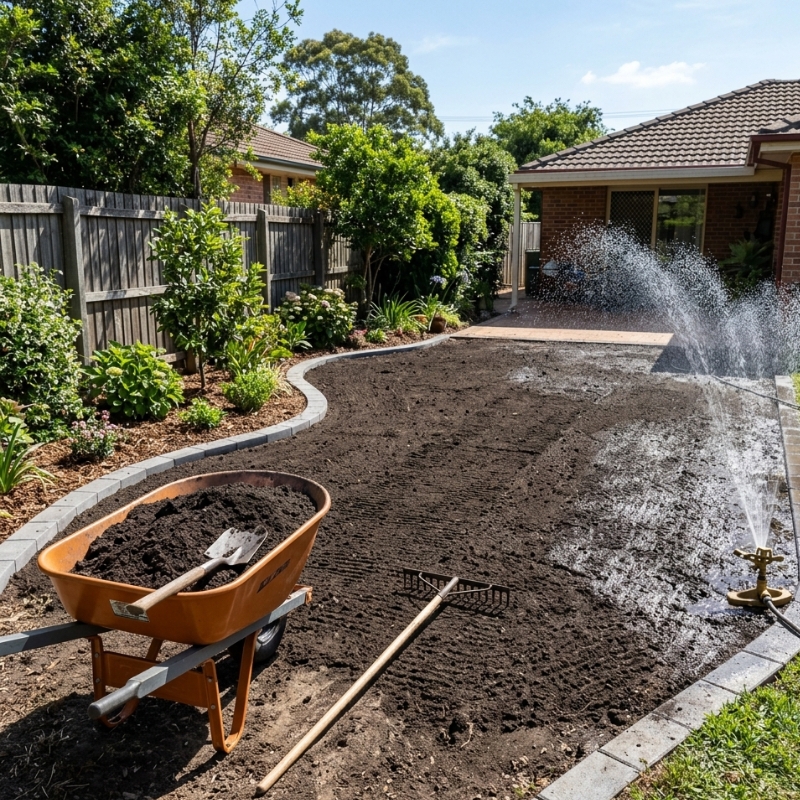
A new lawn can make a Sydney backyard feel brand new overnight — but the result you get depends heavily on what happens before the turf arrives. Even the best turf can struggle if the ground is uneven, compacted, waterlogged, or full of runners and weeds. If you’re planning turf laying, think of this as your foundation guide: a clear, practical way to prepare the yard so roots can establish, drainage works, and your lawn lasts beyond the first few weeks.
Sydney conditions can be unforgiving: warm spells, intense rain events, shade from fences and trees, and plenty of heavy clay in many suburbs. The good news is that lawn prep isn’t mysterious. It’s a sequence of checks and steps that make sure your new grass can actually root, breathe, drain, and stay healthy long term.
This guide walks you through yard preparation the way a pro would: what to fix first, what “level” really means, how to avoid common soil mistakes, and how to set your lawn up so it actually lasts.
The goal of lawn prep (in plain language)
Your new lawn lasts when:
– Water drains away instead of pooling
– Roots can grow down (not hit a compacted “brick” layer)
– The soil holds moisture without staying soggy
– The surface is smooth and correctly graded
– You have a realistic watering plan for Sydney conditions
If you get those five right, turf laying becomes straightforward, and you’ll spend far less time troubleshooting later.
A simple timeline you can follow
You don’t need months. You do need a plan.
10–14 days before
– Decide whether you’re removing the old lawn or laying over bare soil
– Kill off weeds and runners properly (and allow time for them to die back)
– Check drainage and identify any low spots or soggy zones
– Measure the area and plan soil depth and edging
– If you’ll want help with laying new turf, line up your delivery/installation day early so turf isn’t sitting around in the heat
5–7 days before
– Remove old grass and debris
– Loosen compacted soil and shape your levels
– Bring in and spread topsoil (if needed)
– Do your first round of levelling and watering-in
– If you’re unsure about soil blends or levels, turf installation guidance at this stage can prevent expensive rework
24–48 hours before
– Fine level and firm the surface
– Check sprinklers/hoses for coverage
– Make sure the yard is clear and accessible for turf delivery/handling
– Confirm you’re genuinely getting your soil ready for turf (not just making it “look nice” on top)
Step 1: Work out what you’re putting turf onto
Before you touch a shovel, answer this:
Are you installing over bare soil, or replacing an existing lawn?
If you’re replacing an existing lawn, you’ll usually get better long-term results by removing the old layer rather than placing new turf on top of tired soil and old roots.
Reasons to remove the old lawn:
– It’s uneven, bumpy, or riddled with thatch
– It’s full of runners (kikuyu/couch) that will regrow
– The soil underneath is compacted clay
– You have drainage issues already
If you’re unsure, a good “tell” is how water behaves. If it pools now, turf laying without fixing levels and drainage will lock in the problem.
Q&A: Do I really need to remove my old lawn?
If your existing lawn is weedy, uneven, or compacted, removing it is usually worth it. New turf needs clean, breathable soil to root into. Laying turf over problem ground often leads to the same issues coming straight back — which is why getting your soil ready for turf is the real make-or-break step.
Step 2: Check drainage before you do anything else
Drainage is the difference between a lawn that thrives and a lawn that constantly struggles.
Quick DIY drainage test
Pick a spot that tends to stay wet (or do multiple spots across the yard):
– Dig a hole about a spade wide and roughly 30 cm deep
– Fill it with water and let it drain completely (this “pre-wets” the soil)
– Fill it again and time how long it takes to drain
A rough guide:
– Drains within a few hours: generally ok
– Takes most of the day: borderline, needs improvement
– Still holding water the next day: you need drainage fixes before turf
Common Sydney drainage problems
– Heavy clay that seals over (especially after rain)
– A yard that slopes towards the house, not away
– Compaction from construction, foot traffic, or machines
– Downpipes or stormwater outlets dumping into the lawn area
– Low spots that collect runoff from paved areas
Practical fixes (before turf arrives)
– Regrade the surface so water moves away from structures
– Break up compaction (more on that below)
– Add organic matter to improve soil structure (not just sand on top)
– Consider an ag pipe or strip drain if you have persistent wet patches
If your yard stays boggy after rain, this is where turf installation guidance can be especially useful, because drainage and grading mistakes are the hardest ones to “fix later”.
Step 3: Remove old grass, weeds, and runners properly
A new lawn won’t “smother everything underneath” the way people hope. Weeds and runners can punch through joins and edges surprisingly quickly.
How to remove the existing lawn
Options:
– Turf cutter (fast and clean for larger areas)
– Rotary hoe (can work, but can also spread runners if you’re not careful)
– Manual stripping (small areas only, but effective)
The key is removing the old mat and as much runner material as practical, especially around edges. If you’re planning turf laying soon, this step is worth doing properly, even if it’s not the “fun” part.
Weed control (important if you’ve got kikuyu or couch)
If the area is riddled with runners, you want them dead, not just chopped up. Chopping runners can create multiple regrowth points.
Leave enough time for weeds to die back after treatment. Don’t rush straight into soil work if you’ve just applied a herbicide—follow label directions and safety precautions.
Q&A: Can I lay new turf straight over weeds?
It’s not recommended. Weeds compete for water and nutrients, and many will grow through the turf (especially runners). Your lawn may look great for a short time, then start thinning as weeds return — even if the turf itself was high quality.
Step 4: Fix compaction so roots can actually grow
In many Sydney yards, compaction is the hidden issue. The surface might look fine, but underneath it’s tight and airless.
How to check compaction
– Push a screwdriver or garden stake into the soil after watering
– If it barely penetrates, you’ve got compaction
How deep should you loosen the soil?
Aim for around 10–15 cm of loosened soil for most residential lawns. If the soil is extremely hard or the site has been built on recently, you may need deeper remediation in problem spots.
Ways to loosen:
– Rotary hoe (good for bigger areas)
– Garden fork (small areas or spot work)
– Core aeration (helpful but often not enough alone for a full replacement)
Avoid this common mistake: creating layers
One of the fastest ways to cause drainage trouble is to add a “nice” new topsoil layer on top of compacted clay without blending and loosening underneath. Water can sit at the boundary between layers, creating a soggy, shallow root zone.
You want a gradual transition, not a neat “cake layer”. This is the difference between “it looked great for a month” and a lawn that lasts.
Step 5: Get soil depth and soil type right
Your new lawn is only as good as the soil it’s rooting into.
| Section | Summary |
| Soil depth | Your new lawn depends on the soil beneath it, not just the turf on top. |
| Topsoil needs | Good existing soil may only need a light top-up to smooth levels. |
| Poor soil | Sandy fill or heavy clay may need quality lawn underlay/topsoil to improve the root zone. |
| Sydney clay | Holds water and nutrients, but can compact and suffocate roots. |
| Sandy soil | Drains fast, but dries out quickly and loses nutrients. |
| Best approach | Aim for balanced soil structure, good grading, organic matter, and a watering plan suited to your soil. |
| When to get help | Turf installation guidance can help prevent adding the wrong materials or overcorrecting soil problems. |
Most Sydney suburban lawns need a balance: improved structure (organic matter), good grading, and a watering plan that suits the soil. If this is where you feel stuck, turf installation guidance can help you avoid overcorrecting (for example, adding the wrong materials in the wrong way).
Q&A: Should I add sand to clay soil?
A little sand on its own often doesn’t fix clay, and in some mixes can make things worse if the proportions are off. The better approach is improving structure by loosening deeply and incorporating organic matter and suitable soil blends so the soil aggregates and drains properly.
Step 6: Level properly (and make sure the fall is right)
Levelling isn’t about making your yard perfectly flat. It’s about making it smooth and safe, while still encouraging water to move where you want it.
What “good level” looks like
– No visible humps or hollows
– A consistent surface that won’t scalp when you mow
– A gentle fall away from buildings (so water doesn’t run toward your slab/foundations)
– Finished height that works with edging, paths, and drains
Tools that make a big difference
– Landscaping rake
– Straight edge/level (even a long piece of timber works)
– Lawn roller (used lightly) or simply firming with feet in stages
Watch your finished height
You want turf to sit neatly against:
– Paths and pavers (avoid creating a trip edge)
– Garden beds (avoid having turf higher than the bed edge)
– Drains and grates (avoid covering or trapping water)
If you’re preparing for turf laying around existing hardscaping, this is where precision matters most.
Step 7: Install edging and define garden beds before turf
If you’re refreshing your whole yard, do your borders first.
Why:
– It locks in your levels
– It reduces turf lifting at edges
– It makes mowing easier and reduces whipper snipper damage
– It helps stop runners from invading beds (or beds invading the lawn)
Edging is also part of getting your soil ready for turf, because it defines your final height and makes levelling far easier.
Step 8: Plan watering before the turf arrives (Sydney reality check)
Most turf failures happen because watering is either:
– Too little (dry patches, shallow roots, shrinkage at joins)
– Too much (soggy soil, fungal issues, shallow rooting)
Do a sprinkler coverage test
Before turf day:
– Run sprinklers/hoses and watch where water actually lands
– Identify dry stripes and overspray
– Adjust heads or plan to move sprinklers to cover evenly
Even coverage matters more than people think. One missed strip can turn into a permanent weak line.
Water-wise considerations in Sydney
Sydney moves through changing conditions, and water restrictions can shift over time. Keep your watering habits aligned with current guidance. Sydney Water’s Water Wise information is a good reference point for sensible outdoor water use and restrictions planning.
Q&A: When should I start watering new turf?
Plan to water immediately after installation and follow a consistent schedule during establishment. The exact timing depends on heat, wind, shade, and soil type, but your prep work (good soil, good levels, good coverage) will reduce how hard watering has to work.
Step 9: Create an “arrival day” plan (so turf doesn’t suffer)
Turf is living. Once it arrives, time and heat matter.
Before delivery:
– Ensure access is clear (gate width, clear path, no parked cars blocking)
– Have wheelbarrow, rake, hose/sprinklers ready
– Finish fine levelling and firming the day before
– Avoid leaving soil dusty dry (lightly water to settle, not saturate)
If you need a clear pathway from prep to installation, getting turf laying preparation in Sydney can reduce rushed mistakes on the day (especially in warmer months when turf dries quickly).
The most common prep mistakes that shorten lawn life
If you want your new lawn in Sydney to last, avoid these:
– Skipping drainage checks and covering problems with turf
– Adding topsoil without loosening/blending the base layer
– Leaving runner weeds in place (they return through joins/edges)
– Levelling “flat” without a fall away from the house
– Not planning sprinkler coverage (dry stripes become permanent weak zones)
– Rushing the final firming (turf settles unevenly and scalps when mowing)
A good rule of thumb: if you’re not confident you’re getting your soil ready for turf, don’t rush to turf day. Fixing foundations is always cheaper than replacing turf.
A practical yard prep checklist
Use this as a final run-through:
– Drainage tested in multiple spots
– Low spots identified and filled/graded
– Old lawn/weeds removed (especially runners)
– Soil loosened 10–15 cm (more where needed)
– Soil improved with a suitable blend/organic matter
– Levels smoothed, with correct fall away from structures
– Edging/borders installed
– Sprinklers tested for full coverage
– Yard accessible for turf handling
– Final surface firmed and lightly watered-in
If your checklist is mostly ticked but you’re unsure about the last 10%, turf installation guidance can be the difference between “okay” and “excellent”.
When it’s smart to bring in a professional
DIY prep is doable, but some situations are genuinely hard to solve without the right gear and experience.
Consider professional support if:
– Water sits on the surface the day after rain
– The yard slopes toward the house, or you need significant regrading
– You have very heavy clay that bakes hard and cracks
– You’re battling persistent kikuyu/couch runners
– You’re correcting levels around paths, drains, or a pool
If you’re at that point, getting turf installation guidance can save you from paying twice — once for turf, then again to fix what was underneath.
Final FAQ
How level does the ground need to be for a new lawn?
Smooth and consistent is the goal. You want to remove humps and hollows so mowing is easy and water doesn’t pool. A gentle fall for drainage is more important than being perfectly flat.
How much soil should sit under new turf?
Enough quality soil for roots to establish strongly, and a base that’s loosened so roots can grow down. Thin soil over hard ground is a common reason lawns fail early — and it’s why getting your soil ready for turf matters more than the turf brand.
What if my yard is mostly clay?
Clay isn’t automatically bad, but it must be loosened and improved so it drains and breathes. Focus on breaking compaction, improving structure with appropriate soil blends and organic matter, and grading properly.
Do I need to fertilise before laying turf?
A starter fertiliser can help, but it won’t compensate for poor drainage, compaction, or bad levels. Get the foundations right first.
What’s the biggest reason new lawns don’t last in Sydney?
Poor preparation: drainage issues left in place, compacted soil not corrected, and uneven watering coverage during establishment.
Should I do the prep myself or get help?
If your yard is simple and drains well, DIY prep can work. If you have drainage problems, major levelling needs, heavy compaction, or runner weeds, professional support can be worth it.
If you want the prep-to-install steps tied together in one place, this overview on getting your soil ready for turf is the next-step reference: