
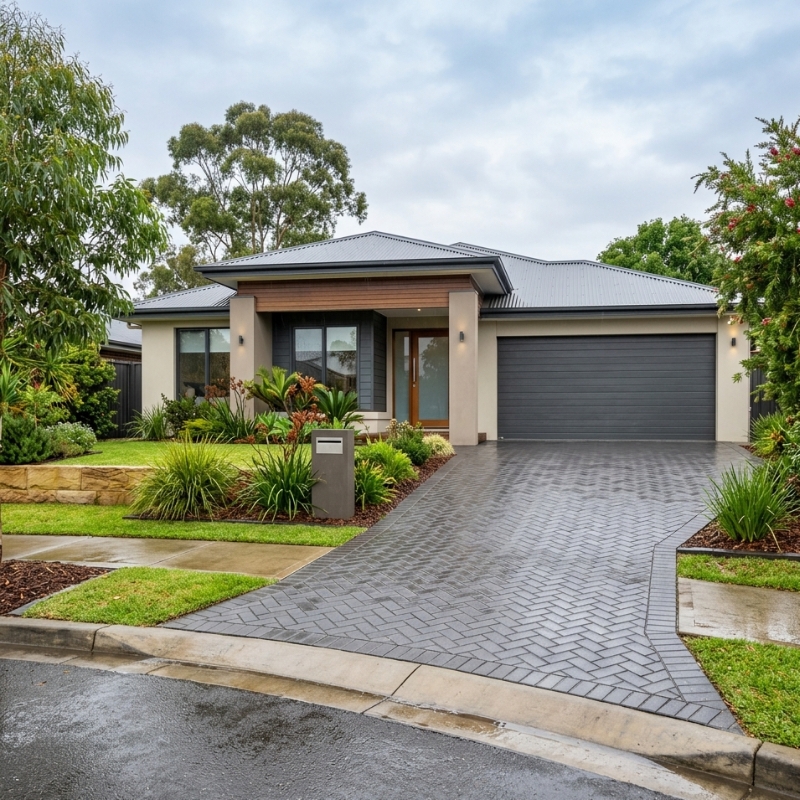
If you’re planning a paved driveway in Sydney, the “pattern” you choose does more than set the style. The direction of the joints, how the units lock together, and where the cuts land can all affect how well the surface handles.:
• turning tyres (especially on tight entries)
• repeated braking and acceleration
• delivery vehicles or heavier cars
• water moving through joints during big rain events
• small ground movements that happen over seasons
The good news is you don’t need to be an engineer to make a smart call. You just need to know what forces your driveway will see, and which layouts resist those forces best.
What actually causes cracking, rutting and shifting?
Most driveway failures aren’t “mysteries”. They tend to come from a few repeat offenders, and pattern choice interacts with all of them.
Cracking: usually a symptom, not the root problem
Cracks (or chipped corners and fractured edges) often show up when stress concentrates in one line. That can happen when:
• the base isn’t evenly compacted (so some spots settle more than others)
• water gets under the surface and softens the support
• edges aren’t restrained, and units spread outward
• straight joint lines run in the same direction as traffic and “unzips” over time
Rutting: repeated load + soft support
Ruts usually form when a wheel repeatedly passes over the same track and the support beneath compresses. Common causes include:
• thin or poorly compacted sub-base
• water getting trapped and pumping fines out
• poor drainage fall (water sits where the tyres load it most)
• a layout that doesn’t share load across neighbouring units
Shifting and rocking: movement starts at weak points
Shifting is often the first sign that something is off. You might notice:
• a slight wobble underfoot
• joints widening in one area
• the edge line creeping outward
• a low spot that collects water after rain
If you want the deeper “why” behind driveway movement, bookmark this for later: paving guidance for homeowners.
The biggest myth: “pattern strength” is only about the pattern
Pattern matters, but it’s not a magic shield. Think of driveway performance as a four-part system:
• base thickness and compaction (support)
• bedding layer consistency (level)
• edge restraint (containment)
• layout/interlock (load sharing)
A strong layout on a weak base still fails, which is why choosing the right base for paving is crucial. A simpler layout on a well-built base often lasts longer than people expect.
Sydney-specific note: many suburbs have reactive clay pockets or mixed fill that can move as moisture changes through the year. Pattern choice can’t stop that movement, but good interlock and edge restraint can make the surface more tolerant, so small movements don’t turn into big defects.
Patterns that typically hold up best on driveways
Here’s how to think about “strength” in plain English: a strong driveway layout resists being pushed apart by tyre turning forces and spreads wheel loads across more units.
Herringbone-style layouts (best for turning forces)
A 45° or 90° herringbone layout is often considered the most resistant to shifting under vehicle turning and braking because the units “lock” in multiple directions. Instead of long, straight joint lines, the joints break up load paths.
When it’s a great fit in Sydney:
• tight turn-in from the street
• short driveway where tyres scrub while turning into the garage
• sloped entries where braking forces are strong
• homes that get regular delivery vans
Trade-offs:
• more cuts around edges and features (more labour and planning)
• busier visual look (not everyone wants it)
• needs crisp edge restraint so the interlock can do its job
Running bond (stretcher bond) (style-friendly, but direction matters)
Running bond looks clean and modern, but on driveways, it can be more sensitive to direction. If the joints run parallel to traffic, the layout can be more likely to “walk” under repeated turning loads (especially if edges are weak). If you rotate it or use it where vehicles travel mostly straight, it can still perform well.
Good fit:
• long, straight driveways with minimal turning
• decorative borders that help “frame” the field
• lighter vehicle use and careful edge restraint
Watch-outs:
• avoid long uninterrupted joint lines in the wheel path
• be extra careful with edges and the first metre near the street crossover
Basket weave and grid-style patterns (OK, but consider your traffic)
These can work, but they often create more continuous joint alignments than herringbone. For a decorative courtyard they’re fine. For a driveway with turning and braking, you’ll usually want either better interlock or stronger edge detailing to compensate.
Good fit:
• driveways with very gentle turning
• areas that are more “car park” than “turning bay”
• when you’re pairing with strong borders and tight jointing
Where pattern choice matters most: the “stress zones”
Even a great layout can fail if it’s designed like a picture instead of a driveway. The goal is to strengthen the zones that get punished.
Zone 1: the garage entry and the turning arc
This is where tyres turn sharply and load the surface while scrubbing sideways. If there’s any weak support, this is usually where rocking or joint loss starts.
Practical tip:
• consider a more interlocking layout in the turning area, even if you keep a simpler look elsewhere (a “hybrid” approach)
Zone 2: the street crossover
This area gets water flow, heavier loads, and sometimes small impacts from vehicles climbing up from the road. It also tends to be where settlement becomes obvious.
Practical tip:
• don’t treat the crossover like “just another section”
• ensure the fall sends water away from the garage and doesn’t trap it in the wheel tracks
Zone 3: edges and curves
Edges are the first place a driveway spreads. If you’ve ever seen a driveway where the outer line bows outward or units tilt, that’s usually edge restraint weakness.
Practical tip:
• curves need especially strong containment because units want to “fan” outward
Q: What’s the strongest pattern for a typical Sydney residential driveway?
A: If your driveway involves turning into a garage (most do), a herringbone-style interlocking layout is generally the safest bet for resisting shifting from turning forces. The catch is it still needs proper base preparation, consistent bedding, and solid edges to perform.
How to choose a pattern based on your driveway scenario
Instead of picking a pattern because it looks good on Pinterest, choose it because it matches your driveway’s “stress profile”.
If you have a tight turn into the garage
Prioritise: interlock + edge strength
Usually suits: herringbone-style layouts, especially in the turning arc
Why: Turning tyres applies a sideways force that tries to shear joint lines apart.
If your driveway is steep or you brake hard at the top/bottom
Prioritise: interlock + drainage
Usually suits: interlocking layouts and careful joint orientation
Why: braking and acceleration create strong directional forces, and water on slopes can wash fines into joints if drainage is wrong.
If you regularly get deliveries, trades, or heavier vehicles
Prioritise: load distribution + base depth
Usually suits: interlocking layouts, with attention to the “wheel path” design
Why: heavier loads amplify any weakness in the base. Pattern helps distribute load, but base design does the heavy lifting.
If you want a calm, modern look
Prioritise: direction + detailing
Usually suits: running bond with smart orientation, plus border design that supports edges
Why: you can keep a minimal aesthetic, but you need to manage long joint lines and avoid creating a “zipper” path in the wheel tracks.
The hidden details that stop patterns from failing
Pattern is the visible part. These are the details that decide whether your driveway stays flat and tight after Sydney’s wet weeks, heat spikes, and normal traffic.
Edge restraint: the non-negotiable for driveways
If edges aren’t properly restrained, the driveway can slowly spread. Once it spreads, joints widen, bedding migrates, and units start rocking.
Common signs your edges are failing:
• the outer line isn’t straight anymore
• joints are wider near the perimeter
• you can feel a slight “tilt” near the edge
• weeds appear mostly along the outside
Drainage fall: water is either managed or it becomes the problem
Driveways need a fall that moves water away from the garage and prevents ponding in wheel tracks. In Sydney, short intense rain events can quickly reveal where water wants to sit.
A useful reference point: builders and industry guidance emphasise designing residential pavements to reduce cracking risk and recognising when engineering advice is needed for tougher situations. See the HIA guidance on designing residential pavements to minimise cracking.
Base prep and compaction: where rutting begins (or doesn’t)
Rutting is rarely “the pattern’s fault” on its own. More often, it’s the base compressing under repeated wheel loads. Once the base compresses, the surface follows.
High-risk clues:
• your driveway sits lower than surrounding ground after rain
• you have visible water paths cutting across the surface
• the wheel tracks hold water longer than the rest
Q: Can a “weaker” pattern still last if everything else is done right?
A: Yes. A visually simple layout can perform very well when the base is properly prepared, drainage is correct, and edges are strong. The more turning and braking you have, the more you benefit from interlock. But base, drainage and restraint are still the foundations.
Style choices that don’t sacrifice durability
You can get a strong driveway without making it look like a heavy-duty industrial surface.
Use borders strategically
Borders can:
• visually frame the driveway (instant curb appeal)
• reduce awkward cuts in the field pattern
• strengthen edge behaviour when combined with proper restraint
Think about joint direction like timber floorboards
If you imagine joints like lines in a timber floor, you’ll instinctively avoid placing long continuous lines exactly where pressure and sideways force repeat.
Practical style move:
• angle the field pattern so joints don’t run perfectly with the main wheel path
Match pattern density to the home
A busy pattern can overwhelm a small frontage, while a calm pattern can underwhelm a character façade. Consider:
• the scale of the driveway area
• whether your home is modern, coastal, federation, or contemporary
• how much visual texture you already have (render, brickwork, planting)
A quick walk-through: how to sanity-check your driveway plan before work starts
You don’t need to micromanage a professional, but you can ask smarter questions and spot risky design choices early.
• Where will vehicles turn and brake hardest? (mark the turning arc)
• Do the joints “line up” in the wheel tracks for long distances?
• How is water meant to leave the driveway during heavy rain?
• What’s keeping the edges from spreading over time?
• What happens at the garage threshold so water doesn’t run inside?
If you’re seeing warning signs already (rocking, widening joints, edge spreading), this will help you work out what’s going on: signs your driveway base needs attention.
Q: What’s the quickest way to tell if a driveway is shifting because of edges or because of the base?
A: If movement is mostly at the perimeter (tilting units, bowed edge line, widening joints near the outside), edge restraint is often the first suspect. If the driveway has a “dip” or low spot in the wheel path or random soft areas across the field, base support or drainage is more likely involved.
Common Sydney pitfalls that make driveways fail faster
These are issues that show up frequently in real homes, especially after a couple of wet seasons.
Relying on pattern to “cover” drainage problems
If water ponds in the wheel tracks, it will eventually find a way into the bedding and base. Once support softens, rutting follows.
Underestimating turning forces
A driveway that’s only 5–7 metres long can get more turning stress than a long straight driveway, because tyres scrub while steering into the garage.
Ignoring edges because they’re “just the edge”
Edges are the first line of defence. When edges creep, the rest of the driveway loosens.
Not planning for shade, algae and slip risk
In leafy Sydney suburbs, shade plus moisture can make surfaces slippery and increase organic build-up in joints. Pattern choice affects cleanability (more joints can mean more places for fines to settle), so pair your pattern choice with a maintenance plan.
FAQ
What pattern is best for heavy vehicles on a residential driveway?
Interlocking layouts tend to handle heavier loads better because they share force across more units. However, for heavier vehicles the base and compaction matter just as much as the layout. If you regularly park a heavy vehicle, the driveway should be designed for that load from day one.
Is a 45-degree layout stronger than a straight layout?
Often, yes, because angling can reduce long continuous joint lines in the direction of travel and help distribute forces. The biggest improvement typically comes from interlock (how the units lock together) and edge restraint.
Why do some driveways get ruts in the same spot?
Because wheels follow the same path every day. If the support under those tracks is slightly weaker, it compresses over time. Water sitting in that path accelerates the problem.
Do borders actually improve durability, or are they only decorative?
Borders can support durability by reducing awkward cuts and helping manage the way the field pattern meets edges. They’re not a substitute for proper edge restraint, but they can be a smart part of a durable design.
How do I reduce the chance of weeds coming through joints?
Weeds usually grow in dust and organic debris that collects in joints, not because they’re “pushing up” from deep below. Good jointing material, tight joints, and occasional cleaning reduce build-up. If weeds return quickly, it can be a sign joints are opening or bedding is migrating.
When should I get someone to inspect movement instead of just re-sanding joints?
If sections are rocking, sinking, or repeatedly opening up after fixes, it’s usually not just a “joints” issue. Look for drainage problems, edge movement, or base softening. Also, treat pooling near the garage or sudden level changes as urgent.