
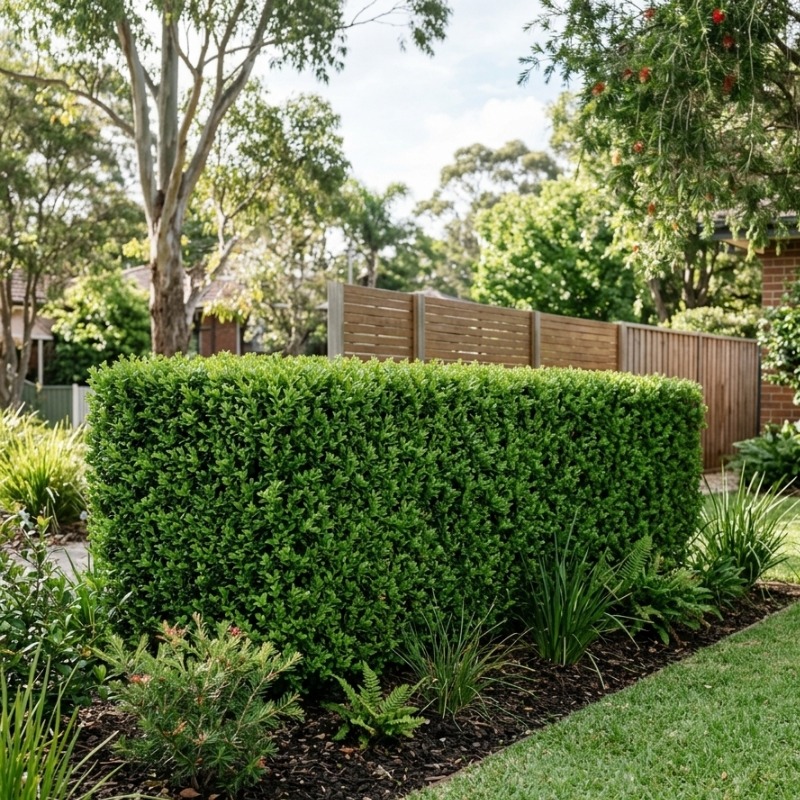
How often should you trim a hedge in Sydney? For most hedges, two to four trims a year does the job, with the main cuts in spring and again in late summer or early autumn. Formal hedges like buxus want more: a few light trims across the growing season to hold that sharp face. Informal, flowering hedges want fewer, usually just a tidy-up once they’ve finished flowering. That’s the short answer. The longer one depends on the species, the look you’re chasing and how fast the thing grows. This guide runs through when to trim the common Sydney hedges, how often, and how to keep one dense, square and healthy without cutting it at the wrong time.
Why does timing matter more than most people think?
Get the timing right and a hedge stays thick, even and healthy. Get it wrong, and you can stress the plant, leave bare patches that take an age to fill, or lop off the flower buds before they open. Hedges do most of their growing in the warmer months, so that’s when regular trims keep them in check and push dense, bushy regrowth. Cut hard in the wrong season, though, and the plant sulks.
Then there’s shape. A hedge trimmed little and often holds a crisp, square line. One left for a year and then hacked back tends to go patchy and woody. So timing isn’t fussiness. It’s the difference between a hedge that more or less looks after itself and one that fights you the whole way.
When should you trim common Sydney hedges?
Different hedges run on different clocks. Here’s how the common Sydney ones behave.
Murraya, or orange jessamine, flowers through the warm months, so give it a trim after each flush to keep it dense and tidy. Late winter into early spring is the time for a harder shaping cut, before the new growth takes off.
Lilly pilly is a fast grower and takes trimming happily. Spring and again in late summer cover most gardens, and if it’s really running you might slip in a third light cut. Keep an eye out for psyllid on the older varieties, and trim off the damaged tips when you see them.
Buxus, or box, is the classic formal hedge, and it earns that neat look with regular light trims. Spring and autumn at the very least, more if you want it razor sharp. Steer clear of cutting in the peak of summer heat, since fresh cuts can scorch.
Photinia (Red Robin) throws bright red new growth every time you cut it, so trimming actually drives the colour. Give it a trim in spring to bring the red on, then keep it up through the season to hold the shape and the colour.
Viburnum makes a solid screen and is pretty relaxed about timing. A shaping cut in spring and a tidy-up in late summer keeps it full. If yours flowers, hold the hard cut until the blooms have gone over.
How often should you trim: formal vs informal hedges?
It comes down to the kind of hedge you’ve got. Formal, clipped hedges, your buxus or a tightly shaped murraya, need the most attention. Often several light trims across the growing season, because the whole point of them is that sharp, even face. Let one go and the crisp line disappears fast.
Informal and flowering hedges are far more forgiving. You’re mostly trimming to keep the size in check and to tidy up after flowering, which for a lot of Sydney gardens means once or twice a year. Rough rule: the more formal the look, the more trims it takes to hold it. None of this is a fixed timetable, though. Growth rate, the weather and how sharp you want the finish all move the number around.
Is it safe to trim in summer heat or mid-winter?
Light trims are generally fine year-round. What you want to avoid is a hard cut in the worst of the summer heat, when fresh cuts can burn and the plant is already stressed, or deep in winter, when growth has all but stopped and the hedge is slow to recover. If you need to take a hedge back hard, aim for late winter to early spring, right before the growth surge, so it bounces back quickly.
What are the signs your hedge is overdue?
A hedge tells you when it’s fallen behind. Look for uneven, whippy growth poking out past the face, bare or thin patches where light can’t reach the inside, and a woody, hollow centre with all the green pushed out to the edges. Flowering hedges that have finished and gone scruffy are due as well.
Catch it early and a normal trim sorts it out. Leave it too long and you’re into renovation territory, which is a bigger, riskier job.
Light trim or a hard renovation prune: when is each safe?
These are two very different cuts. A light maintenance trim just shapes the outer growth and keeps the face tidy. Low risk, and you can do it through the growing season.
A renovation prune is the big one. You’re cutting a neglected, overgrown or hollow hedge back hard to force fresh growth from lower down. It’s the fix for a hedge that’s gone woody, but it’s riskier, and not every plant comes back from it. Timing counts for a lot here. Most hedges handle a hard cut best in late winter or early spring, just ahead of the growth surge, so they can recover quickly. Some species take a hard prune in their stride, others resent it, so it pays to know your plant, or get someone who does, to have a look before you take to it.
What about very tall hedges or hedges near power lines?
This is where it stops being a weekend job. Tall hedges mean ladders, and ladders plus power tools plus uneven ground is exactly how people get hurt. Anything near power lines is more serious again. There are rules about working safely near overhead power lines, and they exist for good reason. If your hedge has grown up around or near lines, don’t take it on yourself. That’s a job for a professional with the right gear, and in some cases the network provider has to be involved.
The same goes for a big, established hedge that’s really turned into a large overgrown shrub or tree that’s beyond hedge scope. Better to have it properly assessed than to guess at it.
DIY or professional hedge trimming in Sydney?
Plenty of hedge trimming is a fair DIY job. A low to medium hedge, a pair of shears or a light trimmer, a bit of patience getting the line straight, and you’re away. Keep it to little and often, and clean your blades between plants so you’re not spreading disease around the garden.
One quick note on the legal side. A hedge growing on your own land is generally yours to trim as you like. It gets more complicated when a hedge or shrub overhangs a boundary, sits right on the line between two properties, or is covered by a heritage or tree protection rule. In those cases the rules differ, so it’s worth reading up on overhanging or boundary planting before you start snipping.
The jobs better handed over are the tall ones, the long runs, anything near power lines, a formal hedge you want dead straight, and a neglected one that needs a careful renovation. That’s where professional hedge trimming across Sydney earns its keep, for the finish and the safety both. Keeping hedges tidy is also part of regular garden upkeep, so if you’d rather not think about it, it can be folded into a maintenance visit.
How do you get a hedge trimming quote with All Green?
If your hedges are overdue, oversized, or you’d just rather leave them to someone who does it day in and day out, All Green can help. We’ve been working with Sydney hedge species and conditions since 2015 (licence 353827C), across homes, strata and commercial sites. Get in touch for a quote and we’ll sort out a one-off trim or a schedule that keeps your hedges dense, square and healthy.
Frequently asked questions
What is the best time of year to trim hedges in Sydney? Spring is the main window, with a second cut in late summer or early autumn suiting most hedges. Formal hedges want more frequent light trims through the growing season. Save any hard renovation cut for late winter or early spring.
How many times a year should I trim a hedge? Anywhere from once or twice for an informal, flowering hedge up to several times for a tightly clipped formal one. Two to four trims a year cover most Sydney gardens.
How do I keep a hedge dense and square? Trim little and often rather than letting it run and cutting hard. Keep the top slightly narrower than the base so light reaches the lower growth, and shape the face evenly each time.
When does a neglected hedge need a renovation prune? When it’s gone woody and hollow in the middle, is bare at the base, or has grown well past the size you want. A hard cut in late winter or early spring gives it the best chance to recover, though not every species takes it well.