You have got a palm that has outgrown its welcome. Maybe it has shot up taller than you ever expected, maybe it is dropping heavy fronds onto the drive, or maybe there is a thick skirt of dead brown material hanging below the green crown making the whole thing look unloved. Here is the first thing to understand: palms are not pruned like other trees, they are cleaned, and that difference matters more than most people realise, because cutting a palm the wrong way can kill it or leave it unsafe. This article gives you a clear read on whether your palm needs a tidy-up or needs to go, how the work is actually done, and what Sydney councils tend to require. All Green handles palm trimming and removal across Sydney, so this is the honest version.
Palms are not pruned like broadleaf trees. A palm is cleaned: dead and hanging fronds, old flower and fruit stalks and loose frond bases are removed, and the green crown is left alone. Over-trimming a palm into a feather duster weakens it. Removal is the answer when the palm is dead, dangerously tall for the site, or lifting paving and footings.
Why can’t you prune a palm like a normal tree?
The answer is in how a palm is built, and it is completely different from a broadleaf tree. A palm has a single growing point, right at the top of the trunk, and everything the plant does comes from that one spot. It has no cambium layer, the living tissue that lets an ordinary tree thicken and heal, and it cannot compartmentalise a wound the way a gum or a jacaranda seals off damage. So when someone cuts into a palm trunk or strips off healthy green fronds, that damage is permanent. There is no growing back from it.
This is why the practice to avoid is the over-trimmed cut that strips the crown back to a thin tuft, often called a hurricane cut or a feather duster. It might look neat and tidy for a season, but it takes away the green fronds the palm needs to feed itself, and it leaves the crown top-heavy and weaker. A palm cut this way is actually more likely to fail in strong wind, not less, which is the opposite of what the owner usually wanted.
What does a proper palm clean involve?
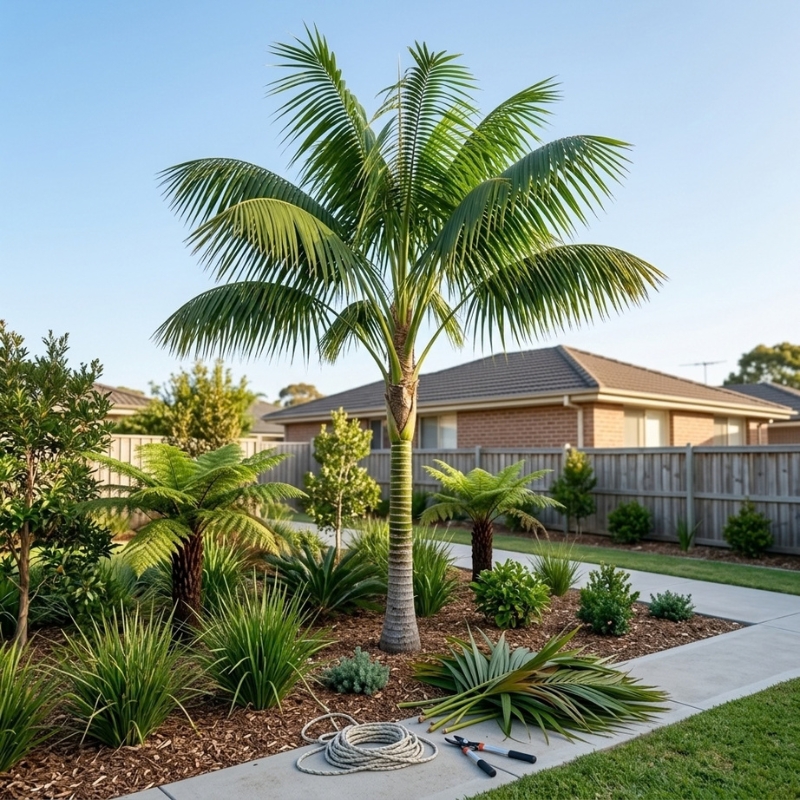
A proper clean removes what is dead and leaves what is alive, and there is a real method to it. The work starts with taking off the fronds that are fully dead or hanging, the brown skirt below the green, which is where most of the mess and weight sits. Next come the flower and fruit stalks, ideally cut before they drop seed and create a litter of sprouting mess and slippery fruit below. Then the loose, old frond bases on the trunk are cleared, because those pockets harbour pests and trap water against the palm.
Access is a job in itself, and it is done carefully. Climbing spikes are never used on a palm that is staying, because they punch permanent holes in the trunk that cannot heal, so the work is done from an elevated platform, a correctly set ladder, or by a climber working on a rope and harness. The debris is the other surprise: palm fronds and trunk sections are heavy and awkward, so the material is gathered from the cleared drop zone and taken away rather than left for you to deal with.
How often do Sydney palms need attention?
Most established Sydney palms want a clean about once a year, though it is a rhythm rather than a hard rule. Some species need it more often, cocos and queen palms in particular, because they fruit heavily and drop a constant mess of seed and old stalks that builds up faster than a once-a-year tidy can keep ahead of.
Timing helps too. Getting a palm cleaned before the summer storm season is sensible, because it takes down the dead and hanging material that is most likely to come loose and fall when the wind picks up. For strata and commercial sites, the clean is often run on a set schedule rather than left until it looks bad, largely for liability reasons, since a frond dropping on a shared path or car park is a risk worth managing in advance. For a home garden, keeping an eye on how much brown is building below the crown is a good enough guide to when it is due.
When does a palm have to come out instead?
Sometimes a clean is not enough and the palm genuinely needs to go. The clearest sign is a dead crown: if the top has browned off or the central spear pulls out easily with a gentle tug, the palm is dead and will not recover. Beyond that, removal is the right call when a palm has outgrown its position and now sits under or tangled in power lines, when the roots or the root plate are lifting paving, a path or a footing, when the species is self-seeding its way across your garden and the neighbours’, or simply when you want the space back for something else.
Taking a palm out is usually done in sections rather than felled in one piece, and there is a good reason for that. A palm trunk does not hinge and fall in a controlled direction the way a timber tree does, so it is rigged and lowered in pieces. The trunk mass is also deceptive: a palm trunk is far heavier than it looks, dense and full of water, which is exactly why the sectional approach and proper rigging matter.
What should you expect on the day?
Palm work is a bit of a production, so it helps to know what the day looks like. Fronds are heavy and the leaf bases are often sharp, so the first job is clearing and controlling the drop zone beneath the palm. Cars get moved, the area underneath is closed off, and the crew works above you, which means nobody stands under the work while it is happening.
It is also worth knowing what you are left with. A freshly cleaned palm looks dramatically barer than you might expect, because all that brown skirt is gone and only the green crown remains, and it will look sparse for a season before it fills back out, which is completely normal. A removed palm leaves a stump, and that is handled as a separate piece of work rather than something that disappears with the trunk. Whichever job it is, All Green takes all the green waste away the same day, so you are not left with a pile of heavy fronds on the nature strip waiting for a council pickup.
Frequently Asked Questions
Can I just cut the dead fronds off myself?
You can cut any fronds you can reach safely from the ground. The problem is almost never the cutting, it is the height and the weight. A frond that looks light from below can be heavy enough to injure someone, and most palm injuries in Sydney happen on ladders, so anything overhead is best left to a crew.
Will trimming a palm make it grow faster?
No. A palm grows from a single point at the very top of the trunk, and removing green fronds takes away the energy it uses to do that, so over-trimming can slow it down. Cleaning off the dead material keeps the palm tidy and safe, but it does not speed up growth at all.
Do I need council approval to remove a palm?
Often yes, and it depends on your council, the species and the size of the palm. Some councils exempt certain palm species and others do not, so there is no single answer. Tell us your address and what the palm is, and we will tell you what applies before any work is quoted.
Clean it or remove it
It comes down to a simple decision. A healthy palm that has just got messy needs a clean, taking off the dead fronds and old stalks while leaving the green crown to do its job. A palm that is dead, dangerously placed or lifting your paving needs to come out instead. If you have a palm you are unsure about, our tree services Sydney team will look at it, tell you whether it needs a clean or needs to go, and check what your council requires. That way you know what you are dealing with before anything is cut, and you are not guessing at whether a trim will do or whether the whole thing has to be rigged and removed.