
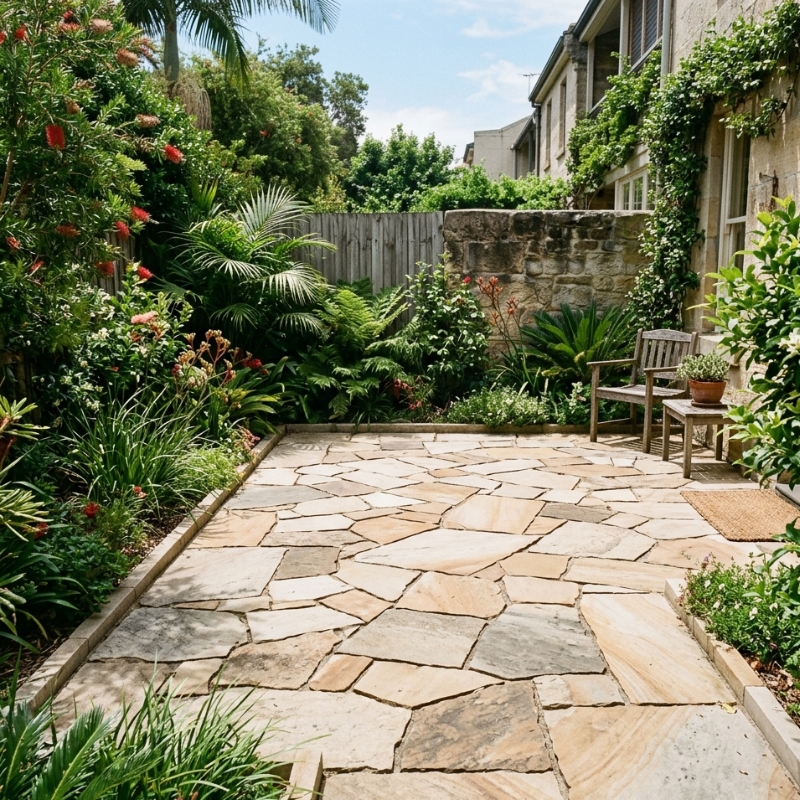
Crazy paving looks effortless when it’s done well. But the best-looking crazy paving rarely happens by accident—it’s usually the result of thoughtful planning before any stone is fixed in place.
This guide focuses on layout planning (not installation): how to dry-lay, choose and mix stone sizes, set joint spacing that looks right, reduce awkward cuts, manage thickness variations, and make the overall pattern feel natural across Sydney backyards, courtyards and garden paths.
Start with the end in mind: what “natural” actually looks like
“Natural” doesn’t mean random. A strong, crazy paving layout usually has these traits:
• A clear overall flow (the eye moves smoothly across the area)
• A balanced mix of large, medium and small stones
• Consistent-ish joint widths (not identical, but not wildly uneven)
• Minimal skinny “sliver” pieces
• Cuts that look deliberate (not like patchwork repairs)
• A tidy edge or border that frames the randomness
Quick reality check: where the layout matters most
Layout planning makes the biggest difference in areas people stare at or walk through every day:
• Front entries and side access paths
• Courtyards and alfresco zones
• Pool-adjacent paving (extra care with slip-resistant finishes)
• Stepping connections between lawn and garden beds
If you’re planning a big outdoor upgrade and want layout advice that suits your space, it can help to review options like paving for Sydney backyards.
Step 1: Measure, sketch, and identify your “viewing angles”
Before you touch a stone, do a simple set-out:
• Measure length/width and mark any curves, steps, drain points, trees, posts or garden edging
• Sketch the area to scale (even a rough sketch helps)
• Stand where people will usually view the paving (from the back door, kitchen window, gate, driveway, pool fence line)
Why viewing angles matter
Crazy paving reads like a “picture” from the main sightlines. If you plan the pattern to look good from the primary viewpoint, the whole area feels more cohesive—even if the edges are tighter or more complex.
Q&A: Do I need a border for crazy paving?
A border isn’t mandatory, but it often makes the finish look sharper and helps the “random” layout feel intentional. Borders work especially well when:
• The paving meets lawn or garden beds
• You have curves (a border can define the curve cleanly)
• The area is small (a frame helps it feel designed, not messy)
Step 2: Choose a stone with the layout in mind (not just colour)
The stone choice affects how easy it is to create a pleasing pattern.
Size mix: pick a range, not one “average”
A good layout usually needs:
• A handful of larger “anchor” stones
• Plenty of medium stones to build the flow
• Smaller infill pieces used sparingly (avoid relying on tiny bits)
If everything is medium-small, the layout can look busy. If everything is huge, you may struggle with edges and curves.
Thickness variation: plan for it now
Crazy paving often comes with thickness variation, which can complicate the layout if you ignore it.
Practical planning move:
• Sort stones into thickness “groups” (thin/medium/thick)
• Aim to keep similar thicknesses near each other in the layout
• Keep the thickest pieces away from areas where you need tight transitions (like door thresholds)
Finish and slip resistance
For Sydney’s outdoor areas, heat and wet weather both matter. Planning is easier when the finish matches the location:
• More textured finishes are often better for wet zones
• A smoother stone may be easier to clean but can be slippery in certain conditions
Step 3: Dry-lay first (the most important planning step)
Dry-laying means placing stones in the area without fixing them—so you can design the pattern before committing.
Set a “working zone”
If the area is large, divide it into manageable sections:
• Courtyards: quarters or thirds
• Paths: 1–2 metre runs at a time
• Backyards: a main “feature” zone first, then expand outward
Place your “anchor stones” first
Anchor stones are your biggest, strongest-looking stones. They set the rhythm.
Rules of thumb:
• Start near the main sightline (like the centre of view from the back door)
• Don’t line anchors up like stepping stones in a row
• Rotate shapes so the pattern doesn’t create obvious stripes
Q&A: Where do the biggest stones go?
Usually:
• In the visual centre of the space
• Near transitions you want to feel “grounded” (like the start of a path)
• Spread out—so one corner doesn’t look heavy, and the other looks thin
Step 4: Decide your joint spacing strategy (and stick to it)
Joint width is one of the biggest “tell-tale” signals of quality. Too inconsistent, and the whole thing looks messy. Too tight everywhere, and it can look forced.
What joint spacing looks best?
For most crazy paving layouts, you’re aiming for:
• A consistent visual rhythm, not a perfect measurement
• Slight variation that looks organic
• Avoiding extreme gaps next to razor-thin joints
A practical approach:
• Choose a “target range” (for example, roughly finger-width to slightly wider)
• Use spacers or simple gauges while dry-laying if you struggle to keep it consistent
Avoid the “river joints”
These are long, snaking gaps that run across the area and draw the eye in a bad way.
To prevent them:
• Rotate stones so long edges don’t keep lining up
• Break long lines with a stone that “crosses” the gap
• If you see a river forming, fix it early—later it’s hard to unsee
Q&A: Should joint width be the same everywhere?
Not exactly, especially with irregular stone. But it should feel consistent. Big, random swings in joint width are what make a layout look unplanned.
Step 5: Create a flow with a simple pattern logic
Crazy paving is “random” inside a hidden logic. Pick one or two guiding ideas:
Option A: The “flow” layout
You subtly guide the eye in one direction (great for paths).
How:
• Place longer stones angled along the path direction
• Use medium stones to reinforce the line
• Avoid a big stone placed sideways that blocks the flow (unless it’s deliberate)
Option B: The “cluster” layout
You create little clusters of similar tone/shape, blended across the area (great for courtyards).
How:
• Group a few stones with similar colour or texture
• Repeat similar groupings in other zones
• Keep it subtle—if clusters are too obvious, it can look patchy
Option C: The “border + chaos” layout
You frame the space, then let the interior be freer.
How:
• A clean edge or border around the perimeter
• A balanced, organic interior with consistent joints
If you want a second set of eyes on layout logic (especially around edges, curves and transitions), consider getting support with crazy paving planning before you commit to cuts.
Step 6: Plan your cuts so they look intentional (and you cut less)
Cutting is unavoidable, but the goal is to cut strategically.
The “cut budget” mindset
Every layout has a cut budget. If you’re cutting constantly, the layout is probably fighting you.
To reduce cuts:
• Use larger anchors to eat up space early
• Keep your stone size mix varied
• Rotate and swap stones rather than forcing a fit
• Don’t lock in edges too early—let the pattern develop, then trim to suit
Hide cuts where they’re least noticeable
Cuts are usually less obvious:
• Along the outer edge (especially near garden beds)
• Under furniture zones in courtyards
• In less-visible corners (not the main sightline)
Cuts are more obvious:
• In the centre of the viewing angle
• When multiple cut edges align in a row
Avoid “pizza-slice” triangles and skinny slivers
Slivers make layouts look fussy and are more likely to crack or dislodge later.
How to avoid them during planning:
• Don’t leave tiny voids as you build the layout
• If a gap is becoming too narrow, pull back and rearrange 3–5 stones around it
• Use a medium stone to “reset” the area rather than plugging holes with tiny bits
Q&A: How do I stop ending up with lots of tiny infill pieces?
It’s usually caused by placing too many medium stones early without anchors, or by letting joints vary too much. Reset the layout:
• Pull up the last section you placed
• Add a larger stone
• Rebuild outward with a more consistent joint rhythm
Step 7: Design the edges and transitions early
Edges can make or break a crazy paving look. A beautiful interior pattern can still look unfinished if the edges are messy.
Common transitions in Sydney outdoor spaces
• Paving to lawn: you want a crisp edge line
• Paving to garden bed: the edge should look clean and resist soil creep
• Paving to steps/landing: align for safe, tidy reveals
• Paving to drain channel: plan stone shapes so the line looks straight and purposeful
Curves: treat them like a feature
Curved paths and garden edges look best when:
• The curve is smooth (not “wobbly”)
• Stones nearest the curve are chosen for shape, not forced
• You avoid lots of tiny cut shards along the curve
A planning trick:
• Mark the curve clearly
• Dry-lay stones slightly beyond the curved line
• Then choose which stones are “best suited” to form the curve before you cut anything
Step 8: Blend colour and texture so it doesn’t look patchy
If you’re working with natural stone, colour variation is part of the charm—but it needs control.
Colour blending rules
• Mix from multiple packs/piles as you lay out (don’t place all of one batch together)
• Step back every few minutes and look at the area from the main sightline
• If one zone is too dark/light, swap stones across zones rather than “fixing” it with small pieces
Veining and grain direction
Some stones have visible grain/veining. A layout looks more natural when:
• Veining directions vary (not all pointing the same way)
• No “stripe” appears across the area
Step 9: Don’t forget drainage and fall in the planning stage
Even though this guide is about layout, drainage planning influences your set-out and transitions.
Key idea:
• Water should generally move away from buildings and towards suitable drainage points
In Sydney, heavy rain events can quickly show up in low spots. If you’re planning falls, it’s worth understanding how stormwater is managed and where runoff should go.
Q&A: Can layout planning help prevent puddles?
Yes. Layout planning helps you:
• Identify low points before anything is fixed
• Avoid creating “bowls” near edges
• Plan transitions near drains so water doesn’t get trapped
Step 10: Use a simple on-site layout checklist
Before you commit to the final layout, do this walk-through:
• Stand at the main viewing angle: does it feel balanced?
• Look for “river joints” and break them up
• Check joint widths: are there any extreme gaps?
• Count slivers: if you see several, rebuild that section
• Check colour: any patchy clusters or harsh contrasts?
• Inspect edges: Does the perimeter look intentional?
• Confirm thickness groupings: Do you see abrupt height changes where you don’t want them?
• Photograph it: photos often reveal pattern problems your eye adapts to
If you’re unsure about any of the above—especially edges, transitions, or tricky levels—getting professional paving help can save a lot of rework later.
Common layout mistakes (and quick fixes)
Mistake: The pattern looks “busy”
Fix:
• Introduce a few larger anchor stones
• Reduce reliance on small infill
• Simplify the joint rhythm
Mistake: Too many long lines
Fix:
• Rotate stones
• Insert a cross-stone to break the line
• Rebuild a small section rather than trying to patch it
Mistake: Patchy colour blocks
Fix:
• Swap stones across zones
• Blend from multiple piles
• Step back to the main viewpoint and adjust
Mistake: Edges look jagged and messy
Fix:
• Add a border concept
• Rework the outer 1–2 stone ring so it frames the interior
• Plan cuts along the edge so they align to a cleaner perimeter
FAQ: Planning a crazy paving layout
How long should I spend dry-laying?
Longer than you think. Dry-laying is where the finished look is created. If you rush it, you usually pay for it later in excessive cutting and a pattern that feels off.
What’s the best way to start a layout—edge-first or centre-first?
Often, centre-first (from the main viewing angle) gives the best visual result, then you work outward and resolve edges. If you have a border, you may establish the border line first, then design the interior.
How do I make a small courtyard look bigger with crazy paving?
• Use fewer, larger stones where possible
• Keep joint widths consistent
• Aim for a calmer pattern flow (less “noise”)
• Avoid heavy contrast blocks of colour in one corner
How do I plan crazy paving for a curved garden path?
• Mark the curve clearly
• Use longer stones angled along the path direction
• Choose curve-adjacent stones for shape
• Avoid lots of tiny cut shards along the curved line
What if my stones vary a lot in thickness?
Sort by thickness first and plan to keep similar thicknesses near each other. Avoid placing the thickest stones in tight transition zones where you need a neat finish.
How do I reduce waste and cut?
• Use a wider mix of stone sizes
• Place anchors early
• Swap and rotate stones before cutting
• Don’t lock edges too early—let the layout develop first