
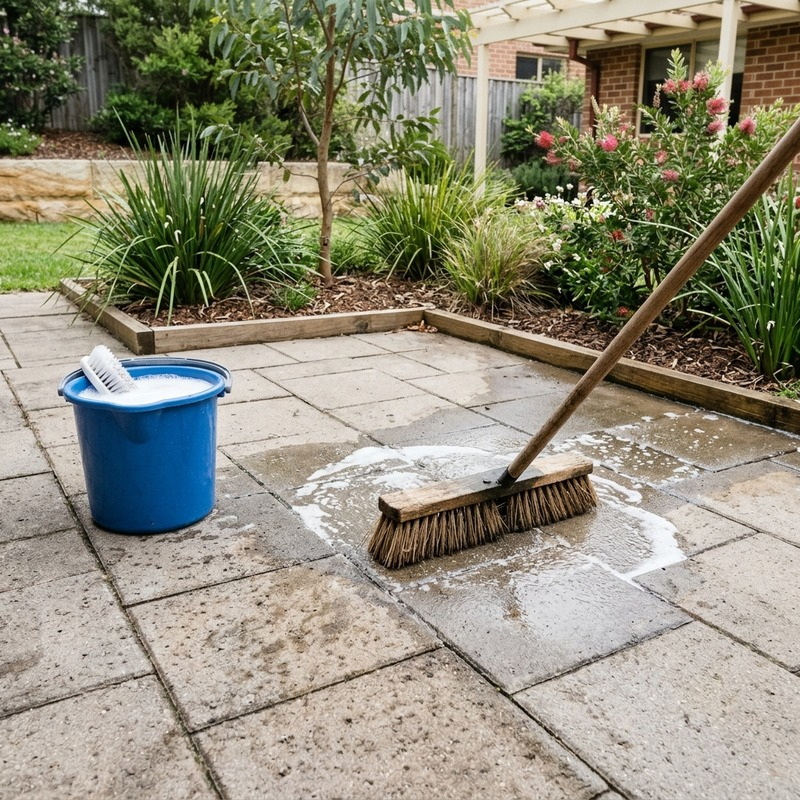
The safest way to learn how to clean pavers is to start gently and escalate only if you have to: sweep the surface, pre-wet it, wash with warm water and a mild detergent using a stiff-bristled broom, leave it to dwell for a few minutes, then rinse from one end to the other. Nine jobs in ten end right there. The damage I get called out to look at almost never comes from dirt. It comes from someone reaching for the strongest product or the highest pressure setting first. If your paving has reached the point where cleaning is not the answer, that is usually a question about professionally laid paving rather than a question about cleaning products, and the two are worth keeping separate.
Work out what you are actually removing
Most of how to clean pavers well is diagnosis, because guessing wrong is how surfaces get ruined. General grime is grey, even and covers the whole area. Organic growth, meaning moss, algae and lichen, is green or black and sits in damp, shaded, poorly drained spots. Efflorescence is the chalky white bloom that appears as salts move to the surface, and it is not dirt at all. Then there are point stains: oil, rust, leaf tannin and red wine, each with its own treatment.
Material matters just as much. Sandstone, limestone and travertine are porous and calcium-based, so acidic cleaners etch them permanently. Concrete and clay pavers tolerate more, and bluestone and granite are tougher again. If you are unsure what you have, treat it as the most delicate option until you know.
The gentle method that handles most paving
Sweep the area thoroughly, then wet it down before any cleaner goes on. Pre-wetting matters more than people expect, because it stops the solution soaking into dry pores and drying there as a stain. Mix warm water with a mild detergent or a pH-neutral paver cleaner, apply it in manageable sections, and work it in with a stiff-bristled broom rather than a wire brush.
Give it five to ten minutes, but do not let it dry on the surface. On a hot Sydney afternoon, that happens faster than you think, so work in the shade or on a cool overcast morning. Then rinse properly, pushing the dirty water in one consistent direction rather than chasing it back and forth. Always test a small out-of-the-way patch and let it dry fully first, because a colour change will not show while the paver is wet.
Vinegar, bleach and the household options
White vinegar is the one everyone reaches for, and it has a real place. Diluted roughly one part vinegar to three or four parts water, it works on light organic growth and general grime on concrete and clay pavers. Apply it, leave it a few minutes, agitate with a broom and rinse thoroughly. The caveat is that vinegar is an acid, so keep it off sandstone, limestone, travertine and other calcium-based stone, where it dulls and etches permanently.
Dish soap is fine, which surprises people. Warm water and a squirt of it is the standard first attempt for grime and fresh spills, and it is gentle on sealers and on nearby plants. Chlorine bleach is different: it kills organic growth but can lighten the paver, damage plants, and must never be mixed with other cleaners. If you use it, keep it well diluted, test first, and water the garden heavily before and after.
Oil, rust and stains that need a targeted fix
Fresh oil wants absorbing, not washing. Cover it with cat litter, sawdust or bicarbonate of soda, leave it several hours, sweep it away, then treat the remainder with a masonry degreaser. Older oil that has soaked in needs a poultice, an absorbent paste left under plastic overnight to pull the stain back out of the pores. It is slow, and it beats scrubbing.
Rust from furniture feet or reinforcing is a chemical problem rather than a scrubbing one and needs a dedicated masonry rust remover, tested first. Leaf and tannin stains respond to an oxygen-based cleaner. Leave efflorescence alone initially, since much of it weathers off; if it persists, try a dry stiff brush first and an efflorescence remover second.
Pressure washing without stripping the surface
A pressure washer is genuinely useful and also the fastest way to ruin a patio. Too much pressure etches concrete, pits sandstone, strips sealer and blasts the jointing sand out of the gaps. Once that sand is gone, the pavers lose their interlock and start to move, a far bigger problem than the stain you were chasing. If your pavers are already rocking or sitting unevenly before you start, pressure is not the issue, and it is worth understanding why the base under pavers matters so much before you spend a weekend cleaning a surface that is going to need lifting anyway.
Used properly, keep it to a low or moderate setting, fit a wide fan tip of around 25 to 40 degrees rather than a pencil jet, hold the wand roughly 300 millimetres back, and sweep in steady overlapping passes at a consistent distance. Hovering in one spot leaves a visible clean halo you will never fully blend out. Work in sections, keep the pressure off the joints as much as you can, and expect to top up jointing sand afterwards.
Jointing sand, and keeping it where it belongs
Sand escapes the joints for three reasons: water washing it out, wind lifting it once dry, and cleaning blasting it out. Refilling is straightforward. Wait until the paving is bone dry, spread fine jointing sand over it, sweep it into the gaps with a soft broom, then top up any joints that have sunk.
Polymeric jointing sand is worth considering where loss is constant. It sets firm once watered in and resists washout, though it has to be installed exactly to the instructions on a dry, swept surface. Whichever you use, check the joints yearly, because full joints are what stop individual pavers rocking.
Sealing, and how often to go over it
A sealer does not clean anything. It slows the rate at which spills soak in, buying you time to wipe them up before they stain. It must go onto a clean, completely dry surface, or you lock the dirt and moisture underneath it. Choose between a penetrating sealer, which leaves the look alone, and a topical one, which adds sheen and needs redoing more often.
For routine care, sweep weekly, hose off every few weeks, and do one proper wash a year, ideally before summer entertaining starts. Deal with spills the day they happen rather than the week after. That rhythm keeps paving looking right with a fraction of the effort a neglected surface eventually demands.
Frequently asked questions
What is the best way to use vinegar to clean pavers?
Dilute white vinegar to about one part vinegar in three or four parts water, pre-wet the paving, apply the solution, leave it five to ten minutes without letting it dry, agitate with a stiff broom and rinse thoroughly. Keep it to concrete and clay pavers only. Do not use it on sandstone, limestone, travertine or other calcium-based stone, because the acid will etch them.
How do you keep sand from coming out of pavers?
Refill the joints with fine jointing sand onto a completely dry surface, sweeping it in and topping up until the gaps are full. Where loss keeps happening, polymeric jointing sand sets firm and resists washout. Keep pressure washing off the joints, make sure water drains away from the paving rather than across it, and check the joints once a year.
Can I use dish soap to clean my pavers?
Yes, and it is the sensible first attempt. Warm water with a small amount of mild dish soap, worked in with a stiff-bristled broom and rinsed off properly, handles general grime and most fresh spills without risk to the paver or the sealer. Rinse well, because leftover residue attracts dirt and shows as a dull patch.
What do professionals use to clean concrete?
Mostly a pH-neutral or mildly alkaline masonry cleaner applied to a pre-wetted surface and given time to dwell, agitated with a broom or a rotary surface cleaner, then rinsed. Specific stains get specific products: a masonry degreaser or poultice for oil, an oxygen-based cleaner for organic marks, and a dedicated remover for rust. The choice is driven by the stain and the substrate, not by strength.
If it has gone past cleaning
Sometimes a wash confirms what you already suspected, and what the area really needs is relaying, repointing or a fresh surface. The team at All Green Gardening & Landscaping has been working on paving across Sydney for more than eleven years and can tell you honestly which of the two you are looking at. Get in touch for a look over your paving.