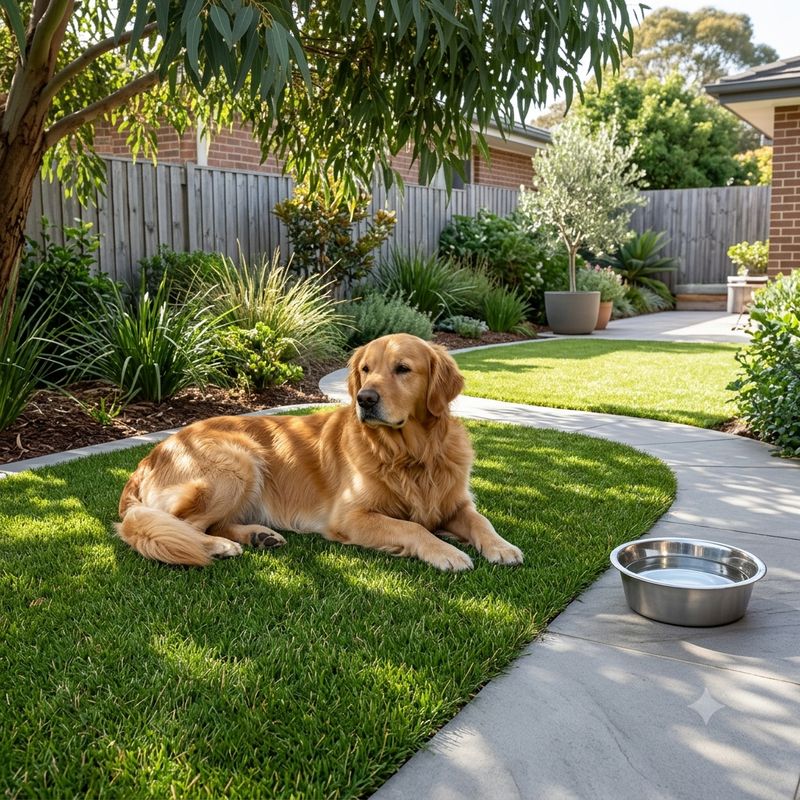
Artificial grass is generally pet friendly, but what decides that is the base underneath rather than the grass itself. A free-draining base lets urine pass straight through instead of sitting in it. The real limitation is surface temperature, because in full summer sun synthetic turf gets considerably hotter than living grass.
The question worth asking is not whether artificial grass is pet friendly in the abstract. It is whether it works in a yard with a dog living in it. Usually it does, and what decides that is almost never the grass you picked. It is what sits underneath it. Artificial grass and synthetic turf installation is work we do across Sydney, on lawns, play areas and courtyards, and the yards that disappoint their owners nearly always come undone at the base. Below are the four things that genuinely matter once a dog is involved, and the two that tend to get oversold along the way.
Drainage is the whole answer
Dog urine is a drainage problem, not a grass problem. That one sentence explains most of the difference between a synthetic lawn that stays fresh for years and one the owner ends up resenting.
Artificial grass itself is inert. The blades do not absorb anything and the backing on quality turf is perforated so liquid passes straight through. What happens next depends entirely on what is sitting below. Where the base is properly prepared and freely permeable, urine drains down and away in the same way rainwater does, and what little residue remains gets flushed out by the next rinse or the next downpour. Nothing stays at the surface long enough to break down and start smelling.
Where the base is compacted clay, old soil that was never excavated, or a layer that has been rolled so hard it has lost its porosity, there is nowhere for liquid to go. It sits in the layer just beneath the turf, it does not dry out properly because the turf above shades it, and it begins to smell within weeks. At that point no amount of cleaning at the surface fixes it, because the problem is not at the surface.
This is also why two yards with identical turf can end up at opposite ends of the scale. The difference was decided before a single roll went down, during preparation, which is the part of the job that is invisible once it is finished and therefore the part most likely to be cut short.
What a permeable base looks like
In plain terms, a base that drains is built from crushed material graded so that water finds a path through it rather than pooling on top. It is compacted enough to stay level underfoot but not so hard that it seals. Beneath it, the ground is excavated to a depth that allows water to keep moving down and away, and the whole thing falls gently towards a point where water can escape rather than sitting in a dish. You do not need to know the specifications to judge it. You need to know that it was excavated, graded and laid as a drainage layer, not simply levelled off.
Heat in full Sydney sun: the honest limitation
Artificial grass gets hotter than real grass in direct summer sun, and that is the one genuine drawback for a dog. Living grass cools itself by moving water up through the plant and releasing it. Synthetic turf cannot do that, so on a clear, still January afternoon an unshaded synthetic lawn will be uncomfortable underfoot in a way that a living one is not. Plenty of pet-friendly content glosses over this. It should not be glossed over, because it is the thing most likely to catch a dog owner out in their first summer.
What reduces it is mostly a question of where the sun lands. A lawn that gets afternoon shade from a tree, a fence line or the house itself behaves very differently from one in open sun all day, so aspect is worth thinking about before you commit, not afterwards. A quick hose down drops the surface temperature straight away, though not permanently, so it works best right before the dog goes out rather than hours earlier. Keeping a shaded spot available, whether that is a tree, a covered area or a patch of planting, gives the dog somewhere to retreat to.
The simplest check is the back of your hand. Hold it against the surface for a few seconds. If it is uncomfortable for you, it is uncomfortable for paws, and that is a good moment to wet it down or wait until later in the day.
Cleaning and smell, realistically
Keeping a synthetic lawn fresh with a dog on it takes less effort than a living lawn, but it does take some. Solids come off promptly, the same as they would from grass, because anything left to break down works its way down between the blades and into the layer where you do not want it. A hose through the area the dog favours, often enough that nothing builds up, does the rest. Most dogs use the same corner, so you are rarely rinsing the whole lawn.
The point people miss is that the rinse needs to go through the turf, not across it. A light spray over the surface moves nothing and achieves nothing. Enough water to carry residue down into the base and away is what actually keeps it clean, which only works if the base drains in the first place.
What does not work is masking the problem. Deodorising sprays and scented treatments cover a smell for a day or two and change nothing underneath. Strong detergents are worse, because they can leave their own residue in the turf. If a synthetic lawn smells persistently after a proper rinse, the issue is drainage below, and no surface product will reach it.
Digging, chewing and the edges
When a dog gets the better of a synthetic lawn, it is almost always at the perimeter or along a join, not in the middle. A dog cannot get purchase on a flat, well-laid surface. It can get purchase on a loose corner, an edge that has lifted slightly away from a path, or a seam that was not properly closed, and once there is something to hook a claw or a tooth under, a determined dog will keep working at it.
That makes edge treatment the detail worth asking about. A perimeter that is properly secured and finished tight against the hard surfaces around it, with joins closed so they sit flush rather than proud, leaves nothing to start on. The same goes for where the lawn meets a garden bed, which is the softest boundary and usually the first place a digger tests.
A dog that digs out of boredom will still dig. The difference is that a well-finished synthetic lawn gives it nowhere obvious to begin, so the habit tends to move to the garden beds instead.
When a real lawn is still the better call
Synthetic is not the right answer for every yard, and it is worth saying so plainly. If your yard is shaded for most of the day, the usual reasons a living lawn fails, which are wear, dryness and bare patches in full sun, may not be your problem at all, and the heat advantage of shade is already yours. Repairing what you have may cost less and suit the dog better.
If your dog digs persistently out of habit rather than opportunity, synthetic removes the easy target but not the behaviour, and you may simply relocate the problem into the garden beds.
And if you want soil you can plant into, change seasonally, or let the dog lie on something that stays cool without being hosed, that is a real preference and synthetic will not satisfy it.
The honest version is that synthetic grass suits high-traffic yards in sun where a living lawn has already failed, and it suits owners who want a surface that looks the same in February as it does in August. If you weigh that up and decide synthetic is right for your yard, the artificial grass installation in Sydney we carry out spends most of its time on the part you never see.
Frequently Asked Questions
Is artificial grass safe for dogs?
Artificial grass suits dogs well in practical terms. The blades are inert, nothing is absorbed, and quality turf is perforated so liquid drains through. What matters for comfort is the base beneath it and the surface temperature in full sun, rather than the grass itself. Shade and a quick rinse address both.
Does artificial grass smell if a dog uses it?
Not where the base drains freely, because urine passes through and away rather than sitting beneath the turf. Smell develops when the base is compacted or poorly prepared and liquid has nowhere to go. In that situation the cause sits below the surface, so cleaning the blades will not resolve it.
Does artificial grass get too hot for paws?
In direct summer sun it gets noticeably hotter than living grass, because it cannot cool itself the way a plant does. Shade, aspect and hosing it down shortly before the dog goes out all reduce it. Test with the back of your hand, and if it feels uncomfortable, wait.
Can a dog dig through artificial grass?
Rarely through the middle, because there is nothing to get a claw under on a flat, well-laid surface. The vulnerable points are loose edges, lifted corners and open joins. A properly secured perimeter finished tight against paths and beds removes the starting point a digger needs.
The part worth paying attention to
If there is one thing to take from all of this, it is that the base decides the outcome. The turf you choose makes very little difference to whether a yard with a dog in it stays fresh or turns into something you apologise for. Excavation, grade, a drainage layer that genuinely drains and a perimeter finished tight are what separate the two, and all of it happens before the grass is unrolled. That is why preparation is the part worth asking questions about when you are comparing quotes, and the part worth paying for properly. It is where All Green Gardening & Landscaping starts every synthetic lawn, and it is where your own conversation with any installer is worth starting too.