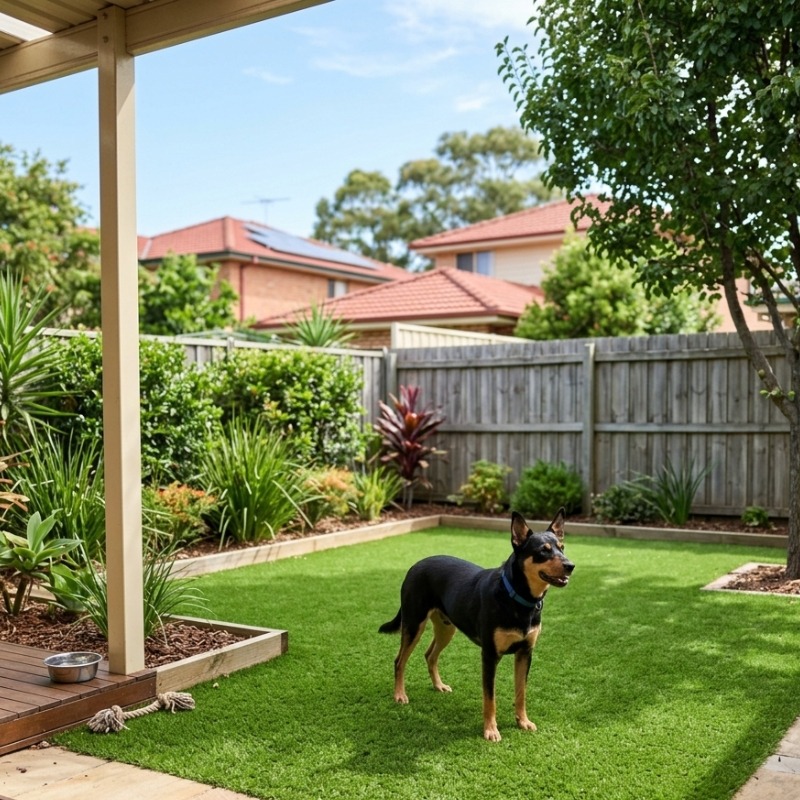
If you’ve got a dog and a patch of yard that’s more mud than lawn, you’ve probably wondered whether artificial grass is the answer. The short version: yes, artificial grass is generally a good fit for pet homes, and a lot of Sydney dog owners switch to it for exactly that reason. It gives you a clean, consistent surface, it drains, and there are no bare patches or bog after a wet week. This guide covers what makes turf pet-friendly, how it handles a Sydney summer, keeping it clean, and what to think about before you install it.
Is artificial grass safe for pets?
For most pets, quality artificial grass is a suitable surface. The turf itself is generally made from materials specified as non-toxic, and it’s widely used in homes with dogs. That said, “pet safe” and “non-toxic” are claims that should be read off the specific product’s specifications rather than taken as a blanket promise, so it’s worth checking the spec sheet of whatever product goes down, and choosing the infill with pets in mind. A good installer will point you to turf and infill suited to homes with dogs.
The bigger safety wins with pet turf are practical ones. There’s no mud for a dog to track through the house, no pesticides or fertilisers on the surface, and no bare dirt to churn up. For a lot of owners, that’s the real appeal.
What makes turf pet friendly?
A few things separate turf built for pets from a bargain roll. The materials matter, so look for turf specified as suitable for pets and infill chosen for pet use rather than a generic sand fill. Drainage matters enormously, since a pet lawn has to let urine and rain pass straight through rather than pool. Some products and infills also offer antimicrobial or odour-control properties, which help with smell, though again that’s a product-specification feature to confirm, not something to assume.
The takeaway is that pet friendliness is mostly about specifying the right turf, the right infill and the right drainage for a home with animals, which is a conversation to have with your installer.
Does artificial grass get too hot in a Sydney summer?
It’s a fair question, because artificial grass can heat up in direct sun more than a natural lawn does. In practice, it’s manageable. Shade makes a big difference, so turf under a tree, a pergola or the shadow of the house stays far more comfortable. On a scorching day, a quick rinse with the hose brings the surface temperature down quickly. And dogs, like people, tend to self-regulate and move to the cool spots. If your yard is full sun with no shade at all, it’s worth factoring that in, and a bit of shade over the main area helps both you and the dog.
How do you deal with dog urine, cleaning and odour?
This is where drainage earns its keep. On a properly installed pet lawn, dog urine drains straight through the turf and the base rather than sitting on top, so it doesn’t leave the brown burn patches a natural lawn gets. For solids, you pick them up the same as you would on grass.
For upkeep, a regular hose-down keeps the turf fresh, and an occasional wash with a pet-safe cleaner handles any smell in high-use spots. The combination of good drainage, the right infill and a routine rinse is what keeps a pet lawn hygienic and odour-free. Get the drainage right at installation and the ongoing cleaning is genuinely easy.
Does it stop digging and muddy paws?
Mostly, yes, and it’s one of the main reasons people make the switch. There’s no loose soil for a dog to dig into once the turf is laid over a compacted base, so the classic muddy hole in the corner becomes a lot harder to create. And with no mud, there are no muddy paw prints marching through the house after every trip outside. A determined digger can still worry at an edge, which is why secure edging matters, but for the everyday churn and mud of an active dog, artificial grass holds up well.
How long does pet turf last, and what affects lifespan?
Good quality artificial grass is built to take wear, and a well-installed pet lawn lasts for many years. Lifespan comes down to the quality of the turf, how well it was installed, how much traffic it gets and how it’s looked after. Heavy daily use from a big, active dog will wear a lawn faster than light use, and a cheap product laid on a poor base won’t go the distance the way a quality one on a proper base will. The base and the drainage do a lot of the quiet work here, which is why installation quality matters as much as the turf you choose.
What are the installation considerations for pet homes?
A pet lawn lives or dies on what’s underneath it. The base needs to be properly prepared and compacted, with drainage built in so urine and water pass straight through. The infill should be chosen with pets in mind. And the edges need to be secured well, both so a digger can’t lift them and so the whole lawn stays put under heavy use. For a surface question that comes up a lot in Sydney, whether to lay over an existing hard surface, our guide on base and surface considerations is worth a read. The short of it is that pet turf is only as good as its installation, so this is not the place to cut corners.
Artificial grass vs a natural lawn for pet owners
For a home with an active dog, the two surfaces behave very differently. A natural lawn with a dog on it tends to end up with worn tracks, bare patches, brown burn spots from urine, mud after rain and holes where the digging happens, and it needs ongoing watering, feeding and weed control to look its best. Artificial grass sidesteps most of that: a consistent green surface all year, no mud, urine that drains away instead of burning patches, and a base that’s harder to dig up.
Natural lawn still has its place, and it’s cooler underfoot in full sun and feels like the real thing, because it is. But for pet owners chasing a clean, hard-wearing, low-fuss surface, artificial grass is often the more practical choice. The right answer depends on your dog, your yard and how you use the space. Our general guide on artificial turf safety is a useful companion read if you’re weighing it up more broadly.
Getting pet-friendly artificial grass installed in Sydney
If a clean, dog-friendly yard sounds like what you’re after, All Green can help you get there. We handle artificial grass installation in Sydney from base preparation and drainage through to the finished lawn, and we can talk you through the turf and infill options suited to a home with pets. We’ve been installing Sydney gardens since 2015 (licence 353827C). Get in touch for a quote and we’ll sort out a pet lawn built to last.
Frequently asked questions
Is artificial grass safe for dogs? Quality artificial grass is generally a suitable surface for dogs and is widely used in pet homes. The materials are usually specified as non-toxic, but check the specific product’s specifications and choose a pet-suited infill rather than assuming.
Does artificial grass smell with dogs? Not when it’s installed and maintained properly. Good drainage lets urine pass straight through, and a regular hose-down plus an occasional wash with a pet-safe cleaner keeps it fresh. Odour usually comes from poor drainage or the wrong infill.
Does artificial grass get too hot for pets in summer? It can warm up in direct sun. Shade over the main area helps a lot, a quick rinse with the hose cools the surface fast, and dogs tend to move to the cooler spots on their own.
How long does pet artificial grass last? A well-installed quality pet lawn lasts many years. Lifespan depends on the turf quality, the base and drainage, how much use it gets and how it’s looked after.