
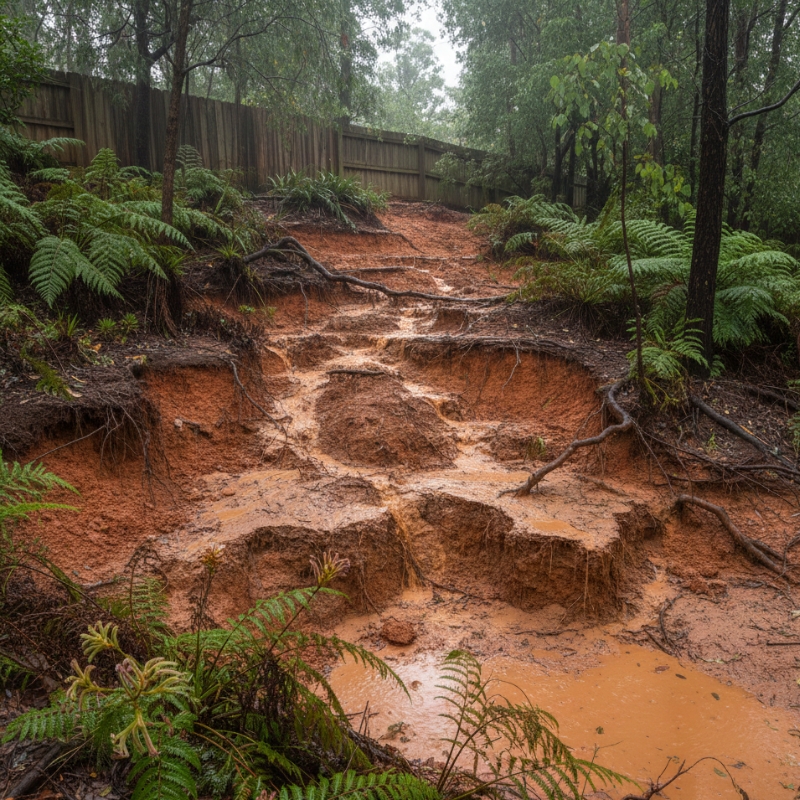
If you’ve ever walked into your backyard after a heavy Sydney downpour and noticed sunken patches, cracked soil, leaning fences or exposed roots, you’re not alone.
Garden soil collapse or shifting after rain is a common issue across Sydney — particularly on sloped blocks and in suburbs with dense clay soil. What often looks like a minor cosmetic problem can sometimes signal deeper structural instability.
Understanding why soil moves is the first step in preventing long-term landscape damage.
Why Heavy Rain Has Such a Big Impact on Sydney Gardens
Sydney’s weather patterns play a major role in soil movement. Intense rainfall events, especially during summer storms or prolonged wet periods, can overwhelm drainage systems and saturate the ground quickly.
When stormwater is not properly controlled or redirected, runoff concentrates in vulnerable areas of the yard. Over time, this repeated saturation increases erosion risk and weakens soil structure. Guidance around sustainable stormwater practices highlights the importance of slowing, absorbing and redirecting water to prevent landscape damage and instability.
In practical terms, that means:
• Water fills air gaps in the soil
• Soil becomes heavier and loses internal strength
• Gravity pulls saturated soil downhill
• Pressure builds against garden edges and structures
On sloping blocks — which are common throughout Sydney — this process accelerates.
The Main Causes of Garden Soil Collapse After Rain
Soil doesn’t just “wash away” randomly. There are specific structural and environmental factors that cause it to shift.
1. Soil Saturation and Loss of Strength
All soil contains air pockets that help maintain structure. When heavy rain fills those gaps with water:
• The soil becomes dense and heavy
• Friction between particles reduces
• The ground loses its load-bearing capacity
This is why areas can suddenly sink or slump after a storm.
In clay-heavy regions of Sydney, the problem is amplified because clay absorbs water and expands. Once it dries, it contracts — creating cracking and uneven settlement.
2. Poor Drainage Design
One of the most common causes of soil movement is inadequate drainage.
If water cannot escape effectively:
• It pools beneath the surface
• Hydrostatic pressure builds
• The soil mass begins to shift outward
This is particularly noticeable behind raised garden beds or along property boundaries.
Over time, recurring saturation weakens the entire garden structure.
3. Sloping Block Instability
Many Sydney homes are built on sloping terrain. While visually appealing, slopes increase:
• Downward gravitational force
• Runoff velocity
• Erosion risk
Without proper structural planning, sloped soil can gradually migrate downhill. During heavy rainfall, this movement speeds up dramatically.
In these cases, structural retaining walls for sloped gardens often form part of the long-term solution — not just to hold soil in place, but to properly manage load and drainage.
4. Inadequate Compaction During Landscaping
If the fill soil wasn’t compacted correctly during previous landscaping:
• Voids remain beneath the surface
• Water seeps into gaps
• Soil collapses into empty pockets
This often shows up as sudden depressions or uneven patches after rain.
Older properties or DIY landscaping jobs are particularly prone to this issue.
5. Erosion from Uncontrolled Runoff
Stormwater flowing across open soil can gradually remove fine particles. Over time, this leads to:
• Exposed roots
• Washed-out garden beds
• Undermined paving
• Edge collapse near fences or pathways
Erosion is progressive — meaning each storm weakens the site further.
Signs Your Soil Movement May Be Structural
Not all shifting soil requires structural intervention. However, certain warning signs indicate deeper instability.
Watch for:
• Large cracks forming across sloped sections
• Soil pulling away from boundaries
• Leaning fences or garden edging
• Bulging ground at the base of a slope
• Repeated sinking in the same area
• Water pooling near foundations
If you notice several of these symptoms together, the issue may go beyond simple drainage and point to load-bearing failure.
Why Sydney’s Clay Soil Makes Things Worse
Clay soil is common throughout Western Sydney, the Hills District and parts of the North Shore.
Clay behaves differently from sandy soil:
• It expands when wet
• It contracts when dry
• It holds water longer
• It drains slowly
This expansion-contraction cycle creates movement stress within the soil mass. When combined with slope and heavy rainfall, it significantly increases collapse risk.
This is why soil movement after storms is more common in certain suburbs.
Common Question: Why Does My Garden Sink After Heavy Rain?
When soil sinks after rain, it usually means:
• Water has displaced air pockets
• Fill soil was poorly compacted
• Subsoil has eroded beneath the surface
• Water is draining into voids underground
Sinking is rarely random. It’s almost always linked to water pressure or structural weakness below ground level.
When Is It Just Cosmetic — And When Is It Serious?
Minor surface wash or shallow erosion can often be managed with:
• Regrading soil
• Improving drainage
• Adding ground cover plants
• Installing surface channels
However, more serious issues require assessment when:
• Soil movement is ongoing
• There is a visible separation along the edges
• Structural elements are affected
• Water continues pooling after rain stops
In these situations, retaining wall support for soil stability may be required to properly reinforce the affected area and prevent further displacement.
The Role of Structural Reinforcement
When soil repeatedly shifts, collapses or erodes, the underlying issue is often structural load mismanagement.
A properly engineered retaining system does more than hold soil:
• It redistributes weight safely
• It manages hydrostatic pressure
• It incorporates drainage behind the structure
• It prevents downhill migration
For properties with steep gradients, professional retaining wall installation is often the long-term corrective solution rather than temporary patchwork fixes.
Importantly, structural solutions should be designed with drainage integration — otherwise, pressure will rebuild.
How Heavy Rain Creates Hydrostatic Pressure
Hydrostatic pressure is one of the most misunderstood causes of soil failure.
When water accumulates in soil:
• It increases internal pressure
• It pushes laterally against boundaries
• It reduces friction between particles
This pressure forces soil outward or downward, particularly behind slopes or raised areas.
Over time, repeated pressure cycles weaken the site permanently.
Common Question: Is Soil Movement Normal on a Slope?
Some minor movement is natural over time. However, rapid changes after rainfall are not considered normal.
If soil visibly shifts after each heavy storm, that suggests:
• Insufficient structural support
• Poor drainage
• Inadequate soil compaction
This pattern should not be ignored.
Preventative Measures for Sydney Homeowners
While structural reinforcement may be necessary in advanced cases, early prevention can reduce risk.
Consider:
• Ensuring downpipes direct water away from slopes
• Installing proper subsoil drainage
• Maintaining vegetation to stabilise topsoil
• Avoiding overwatering during wet periods
• Monitoring known weak areas after storms
If preventative steps fail to stop movement, escalation may be required.
When to Seek Professional Assessment
You should consider expert evaluation if:
• Soil movement worsens each wet season
• Structural cracks appear nearby
• Garden beds are separating from paved areas
• Sections of your yard feel unstable underfoot
• Drainage improvements haven’t resolved the issue
At this stage, a properly designed structural solution may be needed to prevent long-term damage to landscaping and surrounding infrastructure.
How This Connects to Retaining Walls
Retaining systems are specifically designed to address the underlying causes of soil collapse:
• They resist lateral earth pressure
• They include integrated drainage systems
• They stabilise sloped terrain
• They prevent further erosion
For many Sydney properties built on gradients, structural retaining walls for sloped gardens form part of a broader soil stabilisation strategy — not just a cosmetic landscaping feature.
Importantly, installing a retaining wall is not simply stacking blocks. It requires proper footing depth, drainage design, backfill material and load calculation.
Without these elements, failure can occur over time.
Frequently Asked Questions
Why does soil wash away even if my garden looks level?
Even small gradients allow water to move. If drainage isn’t properly controlled, runoff can gradually remove fine particles and destabilise the surface.
Can planting more grass stop erosion?
Vegetation helps stabilise topsoil, but it does not address structural subsoil instability or hydrostatic pressure issues.
How do I know if I need structural reinforcement?
If movement is recurring, worsening or affecting built elements, reinforcement may be necessary rather than surface-level fixes.
Is heavy rain alone enough to cause collapse?
Heavy rain exposes weaknesses that already exist. It usually acts as a trigger rather than the sole cause.
Does clay soil always require structural support?
Not always — but clay-heavy, sloped sites are more prone to movement and may require engineered solutions depending on severity.
Final Thoughts
Garden soil collapse after heavy rain isn’t just frustrating — it’s often a warning sign.
In Sydney, where clay soil, sloping blocks and intense rainfall intersect, soil movement is common. The key is identifying whether the issue is surface-level erosion or deeper structural instability.
When water pressure, slope load and poor drainage combine, soil displacement becomes a recurring pattern. In those cases, structural intervention — including retaining wall support for soil stability — may be the most reliable long-term solution.
Understanding the cause helps you act early, protect your landscape and avoid progressive damage.