
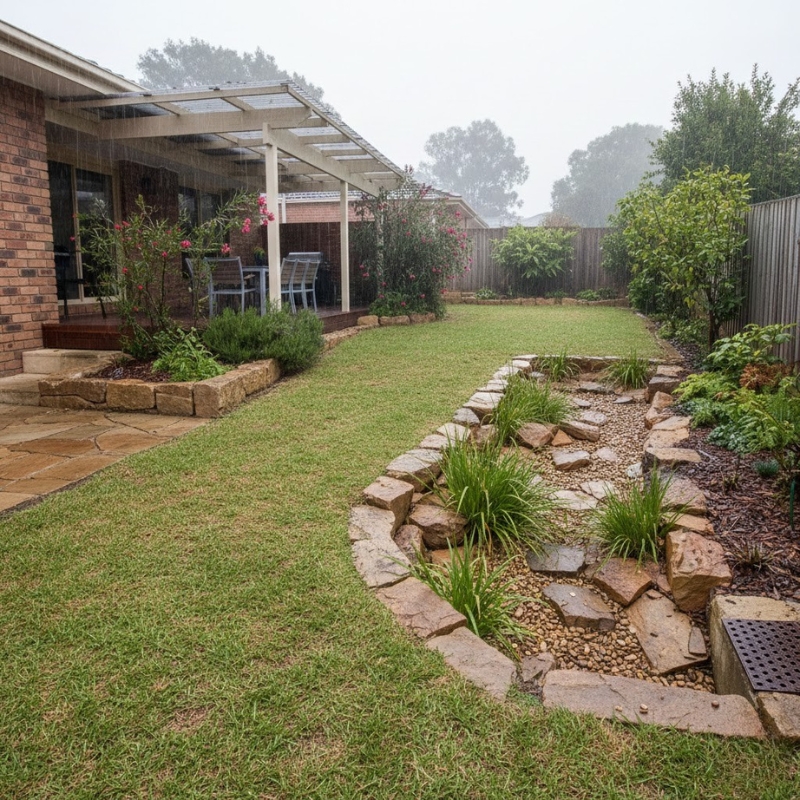
Sydney backyards often look “fine” on a dry day, then turn into a messy reality the moment we get a decent downpour. Water funnels to the wrong spot, a lawn stays soggy for days, mulch floats into paths, or you notice damp patches near the house.
Here’s the thing most people learn the hard way: drainage hardware rarely fixes a level problem. If the ground is sending water toward the house, trapping it in a low point, or rushing it down a shortcut, you can install all the grates and pipes you want and still be chasing symptoms.
This guide helps you diagnose what’s happening and fix the ground first, so any drainage you add is targeted and actually works.
Start with a simple rain test
You don’t need fancy tools to learn a lot quickly. You need one wet day, 15 minutes, and a phone camera.
What to do
• Walk the yard during steady rain (or right after)
• Film where water appears, where it flows, and where it disappears
• Pay attention to hard surfaces (paths, patios, driveways) and edges (fences, side passages)
• Note any areas that stay dark and boggy for 24–48 hours after rain
What you’re looking for
• Water flowing toward the house or pooling near footings
• Water running along a fence line and collecting at the back corner
• “Sheets” of water sliding off paving and stripping soil from garden beds
• A low point where water sits with no obvious exit
• Erosion channels forming down a slope (even small ones)
If you can identify the water’s “story” — where it starts, travels, and ends — you’re already ahead of most DIY fixes.
How to tell if it’s a level problem or a drainage problem
Most Sydney yards have a mix of both. The trick is to work in the right order.
Levels problem clues
• The yard has a clear low point where water collects
• Surfaces were added (paving, turf, edging) without a consistent fall
• Water flows in the wrong direction (toward doors, garage, weep holes, slab edges)
• You see “bathtub” garden beds boxed in by edging or paving
Level problems are about shape: the ground is directing water incorrectly.
Drainage problem clues
• The yard has reasonable falls but still stays soggy
• You have heavy clay pockets that hold moisture
• Water emerges from the ground downhill after rain (subsurface flow)
• A section becomes waterlogged even without obvious runoff
Drainage problems are about how fast water can soak in and move away.
Quick answer
If water is visibly travelling to the wrong place, start with the levels. If water sits with no visible inflow, you may need subsoil drainage — but levels still matter because you need somewhere for water to go.
The “fix the ground first” sequence
When you follow this order, solutions become clearer and cheaper.
1) Decide where water should go
In most residential settings, water should be guided to a lawful discharge point (often stormwater infrastructure) rather than dumped into a neighbour’s yard or trapped in yours. Requirements vary by site and council rules, so treat this as general guidance.
A helpful reference for principles is the City of Sydney Stormwater Drainage Manual.
2) Shape the falls (grading) before you pick finishes
Grading doesn’t always mean major earthworks. Sometimes it’s correcting a subtle “reverse fall” that’s sending water to a doorway, or lifting a low corner so water doesn’t pond.
Common grading moves:
• Creating a gentle, consistent fall away from the house
• Eliminating low pockets that have no outlet
• Building a shallow swale (a broad, gentle channel) to guide runoff safely
• Adjusting garden bed edges so they don’t trap water
3) Choose surfaces that don’t create new problems
Hardscape changes runoff dramatically. A new patio can act like a roof: water hits it and runs off quickly.
When planning surfaces, think:
• Where will water shed from this surface?
• What will it hit next — lawn, garden, steps, a boundary wall?
• Will that next zone handle the extra flow without erosion?
4) Add drainage hardware only where it’s truly needed
Now, drains become precision tools, not a guess.
Understanding Sydney yard types (and why they behave differently)
Sydney’s backyard conditions vary widely, but a few patterns come up often.
Clay-heavy pockets
Clay holds water and drains slowly. Lawns can feel spongy, and garden beds can stay wet long after rain.
Practical tactics:
• Improve soil structure over time with organic matter (not a quick fix)
• Avoid sealing too much area with impermeable paving
• Use targeted subsoil drainage in persistently waterlogged zones
Sandstone or shallow soils
Water may run fast over the surface because the soil is shallow, compacted, or sitting on rock. You can get runoff and erosion even if the yard “dries quickly.”
Practical tactics:
• Slow water with broader paths and swales rather than narrow channels
• Use groundcovers and mulch that won’t wash away easily
• Stabilise slopes with planting, terracing, or retained levels (where appropriate)
Terraced or retained yards
Retaining walls introduce a separate risk: trapped water pressure behind the wall.
Practical tactics:
• Ensure retaining walls have adequate drainage behind them
• Watch for early signs of failure (see below)
• Don’t assume a pretty wall is a properly drained wall
Three common Sydney drainage mistakes (and what to do instead)
Mistake 1: Installing a strip drain without fixing the fall
A strip drain can intercept water, but if the paving still falls toward the house, you’re relying on the drain as a band-aid.
Do this instead:
• Correct the fall first
• Use a drain as backup in high-flow pinch points
Mistake 2: Boxing in garden beds with edging like a bathtub
Raised edges look neat, but they can trap runoff inside beds and drown plants.
Do this instead:
• Provide a low outlet point
• Create gentle transitions so water can exit without scouring
Mistake 3: “One drain in the middle” for a whole yard
Water doesn’t move like that. It follows the easiest path and collects in predictable low points.
Do this instead:
• Map flows and collection points
• Fix the major low spot first
• Add targeted interception only where needed
The homeowner’s diagnostic checklist (use this before spending money)
Around the house
• Are there any areas where ground levels sit too high against walls?
• Do you see dampness, bubbling paint, or persistent musty smells near external doors?
• After rain, does water sit near the slab edge or under downpipes?
Across the yard
• Are there visible “channels” where water has carved a path?
• Do stepping stones or pavers rock after rain (soft subgrade)?
• Is there a low corner that never dries?
On sloped blocks
• Does water run straight down the slope, or is it being slowed and spread?
• Are garden beds acting as speed bumps (causing overflow) or sponges (absorbing then releasing)?
• Is there a safe overflow path during heavy rain?
If you’d like help turning these observations into a clear plan, this kind of landscape design planning support can help you prioritise fixes in the right order without redesigning your whole yard.
Which solution fits which problem?
This is where most advice online gets vague, so here’s a practical matching guide.
Grading (reshaping) is best when…
• Water is flowing the wrong way
• You have a defined low point
• Hard surfaces are sending runoff into sensitive areas
Good outcomes:
• Water spreads and slows
• Ponding reduces
• Drains become optional rather than essential
Swales are best when…
• You need to guide water across the lawn or garden gently
• You want a low-visual-impact solution
• You’re dealing with slope runoff that needs a safe path
Swales work well in family yards because they’re usually walkable and can be planted.
Surface drains (grates/strip drains) are best when…
• A hard surface creates a concentrated sheet of water
• You have a pinch point (between the house and the boundary, near the steps)
• You need to intercept the flow before it hits a doorway or garage
Subsoil drainage is best when…
• The ground stays wet long after rain
• Clay is holding moisture
• You have seepage on a lower level
Subsoil drainage needs proper design, outlet planning, and sometimes licensed trade involvement, depending on connection points.
Q&A: Do I need council approval to change drainage?
It depends on the scope and where water is being discharged. Minor landscape grading inside your boundary may be straightforward, but anything involving stormwater connections, significant earthworks, or changes that affect neighbours can trigger approvals or compliance requirements. When in doubt, check your local council guidance and use a qualified professional for anything that could impact stormwater systems.
Red flags that mean “stop DIY and get professional advice”
Sydney weather can be unforgiving on poor drainage, and some risks aren’t worth guessing.
Call a licensed pro if you see:
• Water moving toward the house or collecting near footings
• Persistent dampness under floors or near external walls
• Retaining wall bulging, leaning, or cracking
• Soil washing out from under paving or steps
• Sinkholes or sudden depressions
• Water discharging onto a neighbour’s property
If you’re trying to coordinate grading, surfaces, planting and runoff together, getting outdoor layout guidance can prevent “fixing one thing and breaking another.”
A practical “fix it in stages” plan
Not everyone can tackle everything at once. Here’s a staged approach that reduces regret.
Stage 1: Stop the worst water path
• Identify the most damaging flow (toward house, major pooling, erosion)
• Implement a temporary diversion if needed (small berm, temporary channel)
• Keep water away from vulnerable structures
Stage 2: Correct grading and levels
• Remove/adjust edges that trap water
• Regrade low pockets
• Create safe overflow routes
Stage 3: Lock in surfaces and planting
• Choose permeable options where sensible
• Stabilise slopes with planting and mulching strategies
• Add drainage hardware only in true pinch points
Q&A: What’s the biggest “hidden cost” drainage mistake?
Building a beautiful patio or lawn before you fix the levels. If you have to rip it up to regrade, costs and disruption multiply. Planning the sequence up front is often the cheapest move you can make.
Final FAQ
Why does my yard flood when it rains in Sydney?
Often, it’s a combination of concentrated runoff from hard surfaces, compacted soil, and a low point with no outlet. Start by mapping flows in rain, then fix grading before adding drains.
How do I know if my backyard slope is correct?
If water consistently runs away from the house and doesn’t pond in low spots, your fall is probably functional. If water heads toward doors, garages, or collects in corners, the slope likely needs adjustment.
Is pooling water always a drainage pipe issue?
No. Pooling is often a level issue — the ground is shaped like a bowl. Pipes help only after the surface is directing water to the right place.
What’s the difference between surface drainage and subsoil drainage?
Surface drainage handles water that you can see moving across the ground. Subsoil drainage helps water trapped in the soil profile move away from persistently wet areas.
Can I just add more soil to raise a low spot?
Sometimes, but it needs to be integrated with surrounding falls and edges. Adding soil without shaping the fall can just move the problem or create new ponding.
When should I worry about a retaining wall?
If you see leaning, bulging, cracking, or increased wetness behind the wall after rain, treat it seriously. Water pressure is a common cause of retaining issues.