
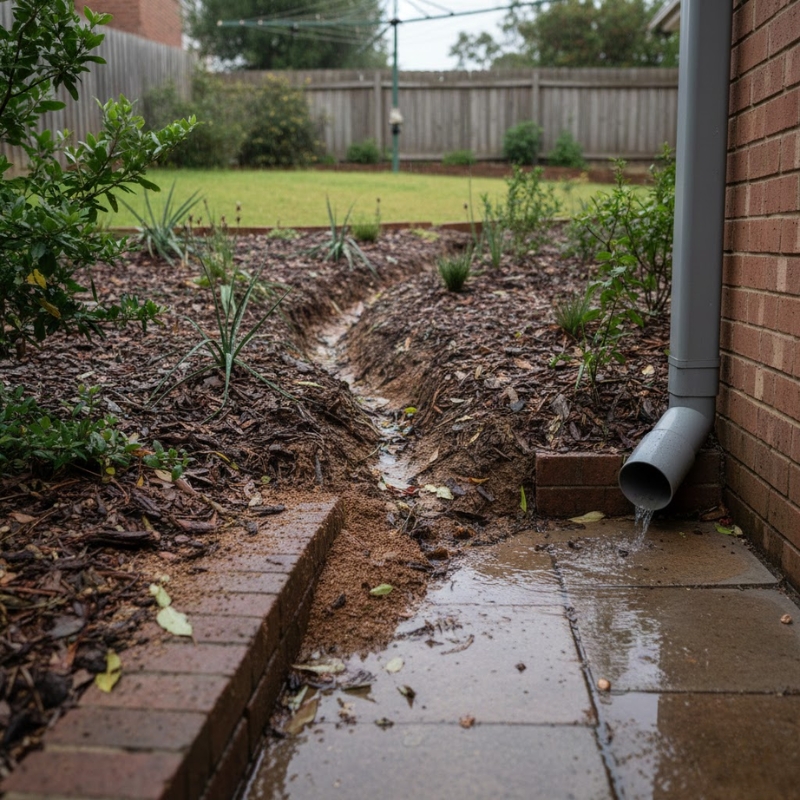
Sydney rain can be gentle for weeks… then arrive in a short, intense burst that turns paths into streams and garden beds into a slurry. Those fast downpours are exactly the kind that strip away topsoil, undercut edges, and leave you wondering why your mulch keeps vanishing.
The tricky part is that erosion often starts small. A thin line carved through a garden bed, a bit of sediment on the driveway, a suddenly exposed root. Left alone, those “little” signs can turn into recurring washouts, sinking pavers, and ongoing muddy runoff that never really settles.
This guide is designed to help you:
• spot erosion early (before it becomes expensive)
• work out why it’s happening in your yard
• take practical steps you can do now, this week, and long-term
• recognise the “don’t ignore this” warning signs near structures and level changes
Sydney and much of coastal NSW can experience heavy rainfall driven by low-pressure systems (including east coast lows), and those events can quickly overwhelm hard surfaces and drainage if water is funnelled into the wrong place.
The quick post-rain walk-through (10 minutes that tells you a lot)
Do this the next time you get a proper downpour:
• Start at your downpipes and driveway and follow where the water actually went
• Check the lowest points of the yard (corners, side access, the back of garden beds)
• Look at edges (lawn-to-bed borders, path edges, near steps, near any level change)
• Note any new channels, sediment fans, or bare patches that weren’t there before
If you’re seeing the same marks after each storm, you’re not dealing with a one-off mess — you’re dealing with a repeating water path.
Early signs your garden is losing soil (not just “a bit muddy”)
1) Thin channels in soil or mulch (rills)
These look like narrow grooves or little “mini-creeks” through beds or across bare ground. They form when water concentrates into a narrow flow and starts scouring soil away, even if the slope looks mild.
What it usually means:
• water is funnelling (often from a downpipe, path edge, or compacted strip)
• the surface is too bare or too smooth to slow the flow
2) Mulch that keeps “disappearing”
If mulch ends up piled in one corner, scattered onto the lawn, or washed onto paving after storms, it’s a big hint that runoff is strong enough to move lightweight material.
What it usually means:
• you’ve got velocity, not just volume
• the bed is acting like a chute (often due to slope + smooth surface)
3) Sediment deposits on paths, pavers, or at the bottom of a slope
Look for a sandy or silty fan where water slows down — near a step, at the edge of a patio, or where lawn meets paving. That sediment came from somewhere uphill.
4) Exposed roots, lifting plants, or “floating” groundcovers
When fine soil washes away, roots get exposed. Plants may look like they’ve been tugged upward or are sitting higher than the surrounding soil.
5) Undercut edges and collapsing borders
Garden edges can be quietly carved out underneath. The top looks intact, but there’s a hollow under the lip. Eventually, it collapses.
6) Sinking pavers or soft spots that weren’t there before
This is a “pay attention” sign. Erosion doesn’t only happen in garden beds — it can also wash out supporting material under paths or near paved areas, leading to settlement.
7) Cracks or separations near level changes
Cracks in soil, gaps opening beside edging, or new separations around steps can indicate movement. Some movement is seasonal — but movement after heavy rain often points to water undermining support.
Why it happens in Sydney yards (the usual culprits)
Most erosion problems boil down to two things:
• water concentrates into a predictable path
• the surface can’t slow it down, soak it in, or safely guide it away
Here are the common causes in Sydney residential settings.
Concentrated roof water (downpipes)
A single downpipe can dump a surprising amount of water fast. If that water exits onto soil, a garden bed, or a narrow side access strip, it can carve channels quickly — especially during intense bursts.
Hard surfaces that act like slides
Driveways, paths, compacted side access, even a smooth lawn slope can speed up runoff. Water moves faster over hard or compacted ground, which increases scouring.
Compacted or clay-heavy soil that sheds water
Many Sydney suburbs have clay or clay-rich profiles. When soil is compacted, water can’t infiltrate quickly, so it runs over the surface and builds speed.
“Accidental drains” created by the yard layout
Common examples:
• the gap between a fence line and paving becomes a channel
• a garden edge creates a neat little “gutter”
• a slight dip beside steps becomes the main flow path
Bare patches and thin lawn
Vegetation is a natural brake. Bare soil is easy pickings for fast runoff. NSW resources consistently emphasise groundcover and managing flow as core erosion-control strategies. (NSW Government)
Q&A: Is my garden actually eroding, or just messy after rain?
If you can hose it clean and it doesn’t come back, it was probably just debris.
If you’re seeing any of these after multiple rain events, it’s erosion:
• repeated channels forming in the same place
• sediment showing up downhill
• mulch relocating downhill
• edges getting undercut
• surfaces settling or softening in the same spots
What to do right now (before the next storm)
Think “stabilise first, beautify later.” Your short-term goal is to stop further loss.
1) Redirect the worst water source (especially downpipes)
If a downpipe is blasting straight into a bed:
• temporarily extend it to a safer discharge point
• add a simple splash zone (rocky area) to reduce scouring where water lands
• avoid sending it straight onto a neighbour’s property or into a spot that will flood
2) Cover exposed soil immediately
Bare soil is vulnerable. Quick wins:
• add a thicker mulch layer (choose chunkier mulch that interlocks better)
• use coir logs / erosion-control mesh on small slopes
• re-seed thin lawn areas or add fast groundcover
3) Break up the “runway”
If water is speeding down a smooth strip:
• add small interruptions (shallow contouring, textured surfaces, small berms)
• avoid creating a perfect channel along edging
4) Protect the edges
Where you see undercutting:
• rebuild the edge and backfill with stable material
• add planting or a denser groundcover to hold the surface together
5) Keep sediment out of drains and the street
Even small residential washouts contribute to sediment in stormwater systems — NSW guidance for erosion and sediment control focuses heavily on reducing sediment movement to protect waterways.
This week: fix the flow path (not just the symptoms)
Map the water routes
After rain (or with a controlled hose test), identify:
• where water starts concentrating
• where it speeds up
• where it drops sediment
Mark the route. Most people are surprised to find the main “stream” is not where they assumed.
Improve infiltration where it makes sense
Options depend on your site, but generally:
• relieve compaction (targeted aeration, soil improvement in garden beds)
• increase organic matter in beds (improves structure)
• use planting to slow and soak
Use “slow, spread, soak” thinking
A good erosion fix usually does three things:
• slows water (reduces scouring)
• spreads it (so it’s not one concentrated jet)
• gives it time to soak (reduces runoff volume)
Consider small landscape reshaping
Sometimes a minor change prevents a major problem:
• a shallow swale to intercept flow
• a raised bed edge that diverts water away from a vulnerable spot
• a safer discharge point for roof water
When erosion becomes a safety/structure issue (don’t ignore these)
Erosion is not only a garden problem when it starts affecting:
• paths and steps (trip hazards, settlement)
• fences (posts lose support)
• level changes (soil moving from behind a change in height)
• areas near the house (water pooling near footings)
Red flags to treat as urgent:
• noticeable ground movement after rain
• repeated sink spots near paving
• widening cracks near a level change
• bulging or leaning at a garden edge that holds back soil
If you’re dealing with a level change that keeps washing out, it may be time to plan a more permanent structure and drainage approach. A useful starting point is a retaining wall planning checklist that helps you think through height, water management, and site constraints.
Q&A: What’s the fastest DIY fix for a small washout?
For small rills and mulch washouts:
• redirect the water source (especially downpipes)
• cover exposed soil immediately (mulch + groundcover)
• add a stable splash zone where water lands
• break up the smooth “runway” so water can’t accelerate
If you fix the surface but not the water route, it usually comes back.
Long-term erosion control that suits Sydney conditions
Groundcover that holds soil together
Plants help in three ways:
• roots bind the soil
• foliage reduces raindrop impact
• coverage slows runoff
Aim for dense, spreading groundcovers on slopes rather than isolated feature plants with bare soil between them.
Smarter surface choices
Where possible:
• reduce large impermeable “slides”
• use permeable or textured surfaces in runoff-prone areas
• avoid smooth, continuous channels along borders
Proper drainage planning (especially for sloped blocks)
Urban runoff is a real factor in how water behaves during storms, and Australian guidance on rainfall/runoff and design rainfall exists because intensity can overwhelm surfaces quickly.
In plain English: you want a yard that can handle intense bursts without turning into a water chute.
If you’re juggling levels, narrow side access, or a steep backyard, it often helps to get the whole water story right — roof water, surface flow, and where it exits. If you’re in that situation, start with help with a sloped backyard planning so you’re not solving one corner while another corner gets worse.
Stabilising level changes
Where a yard has distinct height changes, the most common failure pattern is:
• water gets behind/above the change
• soil becomes saturated
• material starts migrating downhill
That’s why long-term solutions usually combine:
• surface stabilisation (plants/mulch/finishes)
• controlled drainage pathways
• robust support where levels change
For homeowners thinking beyond patch fixes, a practical goal is long-term erosion control that treats water movement as the core design constraint, not an afterthought. This is where a structured plan helps: long-term erosion control should always account for where water comes from, where it concentrates, and where it safely leaves the property.
A simple homeowner checklist (print this mentally after the next storm)
Walk your yard and tick off what you see:
• water pouring from downpipes onto soil
• channels forming in the same places
• mulch drifting downhill
• sediment on paving or at low points
• undercut garden edges
• exposed roots or lifted plants
• soft spots or settlement near paths/steps
• pooling water against the house or fences
If you tick more than two, you’ll get better results by fixing the flow path (source + route), not just replacing mulch.
Final FAQ
How do I know where the water is coming from?
Start at downpipes, then watch how water moves along hard edges (driveway/path/fence line). The highest point where the channel begins is usually the “start” of the problem.
Is mulch enough to stop erosion?
Mulch helps, but it’s not a complete fix if water is concentrated and fast. Mulch works best when combined with redirecting flow, increasing groundcover, and breaking up smooth runoff paths.
Why does erosion get worse over time?
Once a small channel forms, it directs more water next time — which deepens the channel, which captures even more water. Early intervention is easier than repairing major washouts or movement.
What should I do if my pavers are sinking after rain?
Treat it as a sign water is washing out support underneath. Stop further water flow through that area, then investigate base stability and drainage. If it keeps recurring, get it assessed before it becomes a trip hazard.
Are intense storms in NSW becoming more of a concern?
NSW climate adaptation resources highlight that storms and floods can cause significant impacts, and planning for heavy rainfall and runoff is important.
Where can I read a trustworthy overview of erosion management in NSW?
NSW Government has practical guidance on recognising and managing soil erosion, including prevention strategies.