
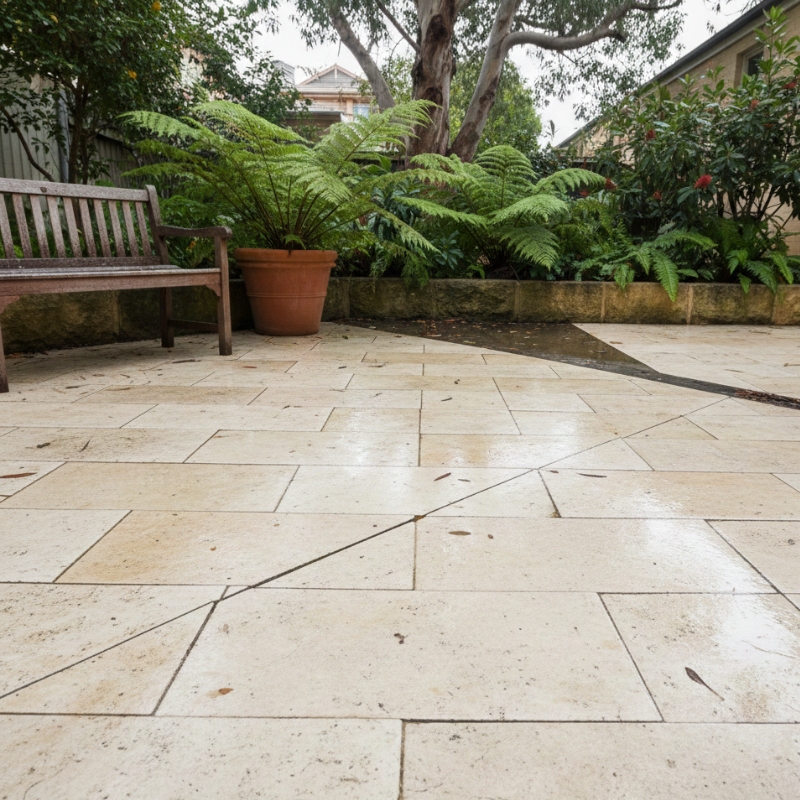
A few marks on outdoor pavers don’t automatically mean something’s “wrong”. In Sydney, paved areas deal with hot summers, sudden downpours, garden watering, and plenty of foot traffic. Over time, you might see a small chip or a single crack.
The difference between normal wear and a real issue is usually movement. If pavers start rocking, sinking, lifting, or changing the way water drains, it’s worth investigating sooner rather than later.
Normal wear vs warning signs: the simplest way to tell
Think in three checks:
• Pattern: one paver, or many in the same area?
• Change: stable for months, or getting worse after rain/heat?
• Consequence: cosmetic only, or causing wobble, pooling water, or trip risk?
Quick check: when to treat it as a warning sign
If you can say “yes” to any of these, it’s more than normal ageing:
• A paver rocks when you step on a corner
• There’s a lip you can catch a toe on (especially near doors/steps)
• Water pools where it used to run off
• Gaps between pavers are widening
• The same spot sinks again after a “quick fix”
• Cracks are appearing along a line across multiple pavers
Q&A: Is it normal for pavers to crack at all?
Sometimes. A single cracked paver can be impact damage (dropped pot, heavy point load) or a one-off weakness. What’s not normal is repeated cracking in the same zone, cracking across multiple pavers, or cracking paired with movement or drainage changes.
What “normal” often looks like around Sydney homes
Sydney doesn’t have freeze–thaw damage like colder climates, but we do have storm-driven washout and moisture-driven ground movement in some areas. Normal wear often looks like:
• Minor edge chipping on high-traffic paths
• A single cracked paver with no surrounding looseness
• Slight fading over time
• Some joint sand loss after years (without pavers loosening)
If the surface still feels firm underfoot and the drainage behaves the same, you may be fine to monitor.
Why pavers crack or move: the most common causes
Most recurring problems aren’t “bad pavers” so much as what’s happening underneath or at the edges.
1) Base and compaction issues
The base carries the load and keeps levels consistent. If parts of the base weren’t compacted properly, were too thin for the use, or were built over mixed ground (old garden bed, fill, soft soil), the surface can settle unevenly.
This is why base design matters so much; if you want the plain-English version, the explanation is that choosing the right base for paving crucial makes the cause-and-effect easy to visualise.
2) Drainage and washout (very common after Sydney downpours)
Heavy rain can wash out bedding sand and fine particles under the edge, creating voids beneath the pavers. Once there’s a void, normal foot traffic can make pavers rock, chip, and crack.
Clues it’s drainage-related:
• Movement is worse after storms
• Sand appears to “disappear” from joints quickly
• Low spots form near the lowest edge
• Water sheets across the surface or pools in the same place
Q&A: Why did my pavers start moving after a big rain event?
Often, because water found a path under an edge, or a downpipe/overflow started discharging where it shouldn’t. Once bedding sand washes out, the pavers lose support and can rock and crack even under normal use.
3) Edge restraint failure
Edges stop pavers from creeping outward. Without strong edging, pavers slowly spread, joints open, and interlock weakens. You might notice:
• Gaps opening at the border
• A drifting, uneven edge line
• A loose strip along one side
4) Soil movement and moisture changes
Some Sydney areas sit on soils that shift as moisture levels change (shrink when dry, swell when wet). Even without a slab, ground movement can affect a flexible paved surface over time.
If you’re curious about the broader concept of reactive sites and classification, the NCC guidance on site classification is a helpful overview.
5) Tree roots and garden growth
Roots can lift sections, especially near mature trees common in established suburbs. Signs include:
• A raised ridge pointing toward a tree
• Lifting concentrated in one strip
• Repeated movement in the same line
6) The area wasn’t built for
A path built for pedestrians can fail if it takes vehicle wheels, skip bins, heavy planters, or repeated high loads. Look for cracking where wheels roll or dips where heavy items sit.
7) Jointing and maintenance factors
Joint sand helps lock pavers together. When it’s missing, pavers can loosen and chip.
Common causes of joint loss:
• Aggressive pressure washing
• Ants or burrowing
• Frequent water flow across joints (overflow/runoff)
A 15-minute inspection walk you can do before deciding what to do next
You don’t need special tools—just time, a phone camera, and a careful eye.
Step 1: Feel for movement
• Step on corners and edges, not just the middle
• Note any rocking, crunching, or “spongy” feel
• Mark the worst spots (chalk or tape helps)
Step 2: Check for trip points
• Look along the surface from a low angle
• Pay attention to door thresholds, steps, and narrow pathways
• Note any lips that catch the sole of your shoe
Step 3: Watch how water behaves
Next rain (or a gentle hose test):
• Does water drain away or pond?
• Does runoff head toward the house?
• Do downpipes discharge onto the paved area?
• Are garden beds spilling onto the paving?
Step 4: Inspect edges and borders
• Are joints opening near the edge?
• Is joint sand missing more at borders?
• Any signs of ants, holes, or washout channels?
Q&A: How can I tell if the base has failed?
A base issue usually shows as a section that keeps changing: it sinks, returns after a quick re-level, spreads over time, or worsens after heavy rain. Rocking pavers across multiple spots and repeated low areas are strong clues.
Symptom-to-cause guide: what you’re seeing and what it usually means
One cracked paver, everything else feels solid
Most likely: impact damage, point load, or a one-off weak paver.
What to do: replace that paver and monitor the area for movement over the next few months.
Rocking pavers in a small cluster
Most likely: minor settlement, joint loss, or small voids in bedding sand.
What to do: lift and re-bed the cluster properly, refill joints, and look for water pathways that could be washing sand out.
A sunken patch that shows up after rain
Most likely: drainage washout, downpipe discharge, irrigation leak, or overflow.
What to do: identify and redirect the water source first. Without fixing the water path, spot repairs often fail.
A neat line of cracks across multiple pavers
Most likely: differential settlement (inconsistent compaction), ground transition (fill vs original soil), or broader movement.
What to do: treat it as a section issue, not a single paver issue. Rebuilding the section with consistent base depth and compaction is often the lasting fix.
Lifting near a garden edge or a tree
Most likely: roots, edge restraint issues, or heave from moisture changes.
What to do: Investigate the driver (roots/water), then reset levels and edging. In some cases, adjusting the layout reduces future conflict—if you’re considering that kind of refresh, it helps to browse ideas like which modern paving designs work best for outdoor spaces? while you plan.
Widespread unevenness across the whole patio/courtyard
Most likely: systemic base/drainage problems or an area built for lighter loads than it’s receiving.
What to do: stop chasing isolated patches and look at the whole system: edging, falls, runoff points, and intended use.
How to prevent repeat cracking and movement
Once the underlying cause is addressed, prevention is mostly about water control and edge stability.
Water management that pays off in Sydney
• Ensure downpipes discharge to an appropriate stormwater point (not onto pavers)
• Reduce constant overflow from garden beds onto paved surfaces
• Fix leaking irrigation early
• Keep the falls working so water doesn’t pond
Maintenance habits that help surfaces stay locked in
• Top up joints if sand is visibly missing
• Avoid blasting joints out with high-pressure cleaning
• Manage ant activity near edges
• Don’t place heavy planters in areas not designed for that load
Q&A: Will sealing stop pavers moving?
Sealing can help with staining and may reduce joint sand loss, but it won’t fix voids under pavers, failed edging, or drainage washout. If pavers are rocking or sinking, the structure underneath needs attention first.
When to involve a professional (without guessing)
Some issues are quick to stabilise; others are symptoms of water or base problems that keep returning. It’s time to get experienced help when:
• There’s a trip hazard or sharp height change
• Water is running toward the house or pooling near the walls
• The problem keeps returning after a repair
• Movement is spreading beyond a small spot
• You suspect roots or broader ground movement are involved
• The area needs to support heavier loads
If you’re seeing those warning signs and want a clear next-step path (without trial-and-error fixes), start with a conversation around scope and options via a paving service in Sydney assessment.
Final FAQs (Sydney homeowners)
Should I replace cracked pavers, or can they be repaired?
If it’s a single paver and the surrounding surface is stable, replacement is often enough. If cracking is widespread or linked to movement, repairs need to address base/drainage/edging, or the problem usually returns.
Why are my pavers cracking in the same spot?
Repeat cracking usually points to a recurring driver: washout, poor compaction, edge creep, or load concentration. Fixing the crack without fixing the driver is why it keeps coming back.
Are gaps between pavers always a problem?
Not always. Small stable joints are normal. Widening gaps—especially near borders—often indicate edge movement or jointing loss.
What’s the biggest red flag to act on quickly?
Trip hazards and drainage changes. If levels are changing or water is pooling or running toward the home, it’s worth addressing sooner.
Can garden watering really affect paved areas?
Yes—particularly if a bed is constantly saturated next to paving or if there are irrigation leaks. Persistent moisture can soften subgrades and contribute to settlement.