
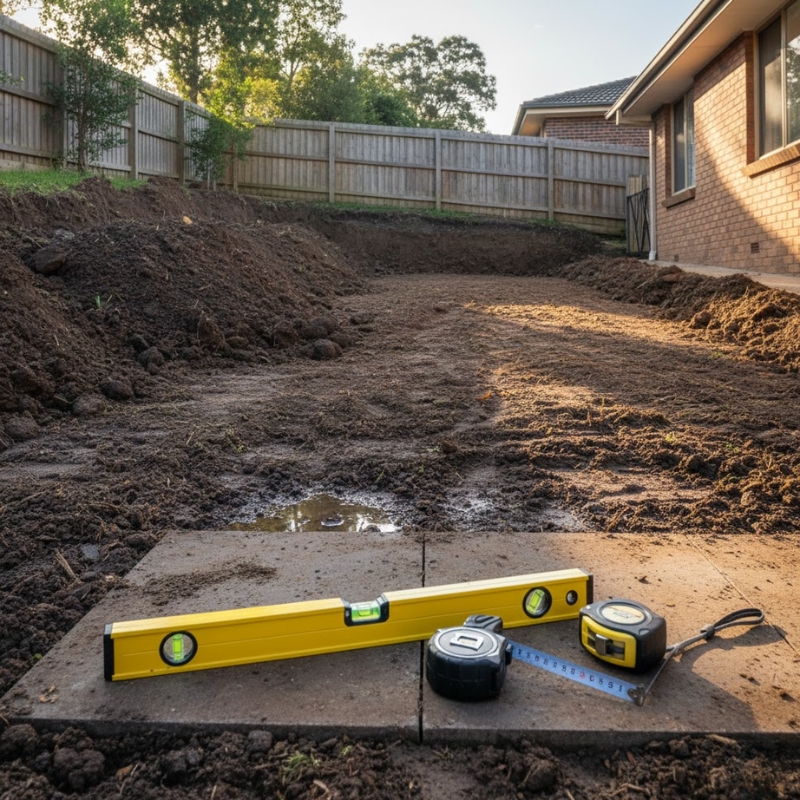
Sydney backyards aren’t flat by default. Between sloping blocks, split-level homes, tight side access, clay soils in many suburbs, and stormwater that can turn a “small tidy-up” into a drainage issue, changing ground levels is one of those projects that can be simple or surprisingly complicated.
If you’re planning to cut into a slope, add fill to create a level lawn area, terrace a garden bed, or create a supported level change, the big question is usually the same:
Do you need council approval?
In NSW, the honest answer is: sometimes. Many small-scale landscaping works can fall under exempt development, but that doesn’t mean “no rules.” Exempt development still requires you to meet specific standards, and there are common triggers that push a project into needing a complying development certificate (CDC) or a development application (DA).
This guide is written for Sydney homeowners who want a practical way to think about approvals before they start digging.
The three approval pathways in NSW, in plain language
Most residential landscaping projects in Sydney will fall into one of these pathways:
Exempt development
This is “no approval needed” in the sense that you don’t lodge an application, but you must meet the relevant standards. If your project doesn’t meet the standards exactly, it’s not exempt.
Complying development (CDC)
This is a faster approval pathway than a DA, but it’s still an approval. A private certifier (or council, in some cases) checks your proposal against set rules. If it meets them, it can be approved as complying development.
Development application (DA)
This is the more detailed assessment process through council. It’s typically required when the work is larger, more complex, or affected by site constraints (think heritage, significant impacts on neighbours, unusual drainage, or works near sensitive areas).
A useful starting point for homeowners is the NSW Planning Portal’s guidance on earthworks, structural supports, and related rules. Here’s the official reference: NSW Planning Portal guidance on earthworks and structural supports.
What counts as a “level change” in a backyard?
A “level change” isn’t only a dramatic excavation. It can include:
• Cutting into a slope to create a flatter lawn
• Filling to raise a low area (especially to improve drainage)
• Creating terraced garden beds
• Regrading around a patio, path, or shed area
• Adjusting levels near fences or boundaries
• Any scenario where soil is being moved in a way that changes the ground profile
If the level change needs something to hold soil in place (for example, to stop it slipping, eroding, or pushing onto a neighbour’s land), you’re moving into the territory of structural support.
That’s where projects most commonly run into approval, engineering, and drainage considerations.
Why approvals matter more than people expect
In Sydney, the biggest practical reasons level-change projects attract scrutiny are:
• Drainage and stormwater impacts (especially where water can be redirected to neighbours)
• Structural stability (soil movement can affect fences, paving, footings, and neighbouring property)
• Boundary issues (tight lots mean works are often close to fences)
• Safety (higher drops, unstable embankments, or loads near driveways and structures)
Even if your project seems small, it’s worth thinking like an assessor: “Will this change affect water flow, stability, or neighbours?”
Q&A: Do I need council approval to level my backyard in Sydney?
If the work is minor, doesn’t create problematic runoff, doesn’t require structural support beyond what’s permitted under exempt development, and meets all relevant standards, it may not need approval. If the work is near boundaries, changes drainage patterns, involves larger cut-and-fill, or requires more substantial structural support, you may need a CDC or DA. When in doubt, checking the NSW Planning Portal pathway and speaking with your local council or a certifier early can save a lot of rework.
The common “approval triggers” Sydney homeowners miss
These are the situations that most often turn a casual landscaping plan into an approvals conversation.
1) Water has nowhere good to go
Sydney downpours are no joke, and many suburbs have reactive clay soils that hold water. If your level change makes water pool, pushes runoff toward a neighbour, or blocks an existing flow path, you can create:
• soggy lawns and subsidence
• water pressure building up behind supported level changes
• disputes with neighbours (especially if their side floods)
Drainage isn’t an optional extra for level changes. It’s core to whether the project is safe and compliant.
If your project involves a supported level change, make sure you understand the drainage basics before any construction decisions. A helpful starting point is this internal reference: drainage basics for retaining walls.
2) Works close to a boundary
Changing levels near a fence line can affect:
• fence stability
• neighbour’s ground level and drainage
• potential encroachment issues
• future maintenance access
Even if you’re not “touching the fence,” soil movement and water movement don’t respect property lines. If you’re within close proximity to a boundary, treat the project as higher-risk and be cautious about assuming it’s exempt.
3) The level difference needs structural support
If the cut or fill creates a steep face that won’t stand on its own, you’ll need a structural solution to hold soil back. That’s where the rules often tighten, and engineering may come into play.
If you’re exploring options for stabilising a level change, use this as a practical primer on what’s involved: retaining wall installation guide.
4) The level change is near a driveway, pool, or structure
Loads matter. Soil held back near a driveway, garage, pool, or the footings of a home can behave differently than soil holding back a garden bed. The risk is higher, and professional design input is more likely to be necessary.
5) Site constraints: heritage, easements, stormwater lines
Sydney has plenty of properties with constraints that can complicate what’s allowed. Easements and underground services in particular can limit where you can excavate or build support structures. If you’re not sure, it’s worth doing a basic constraints check early and, if needed, getting advice before you finalise a plan.
A practical decision guide before you start
This is a homeowner-friendly way to pressure-test your idea.
Step 1: Define the work in one sentence
For example: “We want to cut 300 mm into the back corner to create a level lawn and keep the garden bed on the higher side.”
If you can’t summarise it simply, it may already be complex enough to justify advice.
Step 2: Sketch the before-and-after levels
You don’t need a survey to start thinking clearly. A simple sketch helps you identify:
• where soil is removed (cut)
• where soil is added (fill)
• where water will flow afterward
• where the highest drop-off points will be
Step 3: Ask “what happens in a storm?”
This is the question that saves Sydney homeowners the most pain. In heavy rain:
• would water run toward the house?
• will it run toward a neighbour?
• perhaps get trapped behind the supported level change?
• can it erode new slopes?
If you can’t answer confidently, pause and plan drainage properly.
Step 4: Identify anything “structural”
If soil needs to be held back, or a steep face is created, assume there are additional standards and potentially engineering involved.
Step 5: Check the pathway and constraints
Use the NSW Planning Portal as your starting point, and then check any council-specific overlays or constraints that might apply to your address.
Q&A: What’s the difference between a small garden wall and something that needs certification?
A small, purely landscape feature that doesn’t materially affect drainage, stability, neighbours, or nearby structures may fit within exempt development standards if it meets all requirements. Once the supported level change becomes higher, supports significant loads, sits near a boundary or structure, or involves complex drainage, it becomes more likely that certification, engineering input, or council assessment will be needed.
Drainage and supported level changes: what “good” looks like
If your project includes a supported level change, drainage is one of the most important determinants of long-term performance and safety. “Looks solid” on day one doesn’t mean it will stay that way through Sydney’s wet months.
Good drainage planning usually considers:
• where water naturally travels across the site
• subsurface water in clay soils
• how to relieve water pressure behind the supported level change
• legal stormwater discharge pathways (not into a neighbour’s yard)
Practical warning signs after level works include:
• pooling water near the supported edge
• wet patches that persist days after rain
• soil washing out at the base
• new cracks in nearby paving
• fences starting to lean
If any of those appear, it’s a signal to investigate quickly before movement becomes harder (and more expensive) to address.
Neighbours and boundaries in Sydney: the human factor
Even when a project is technically permitted, neighbour disputes are common when:
• water starts flowing differently
• soil movement affects a shared fence
• access is needed for repairs
• the visual impact changes (for example, a new drop-off near the fence)
Before you begin, it can help to:
• talk to your neighbour early, especially if work is close to the boundary
• document existing conditions with photos
• confirm where water currently flows and where it will go after the change
• keep a simple written record of what you discussed
This doesn’t replace legal advice, but it often prevents misunderstandings from escalating.
When engineering is usually part of the conversation
Homeowners often associate engineering with “big construction,” but in landscaping, engineering typically becomes relevant when stability and loads are significant.
Factors that commonly drive engineering input include:
• higher supported level differences
• loads from vehicles, driveways, or structures nearby
• poor or variable soil conditions
• limited space for safe footing design
• complex drainage conditions
• proximity to boundaries where failure could affect another property
If you’re unsure whether your project is approaching that territory, this internal explainer can help you frame the question clearly: when a retaining wall needs engineering.
Q&A: Can I do cut and fill without a DA in Sydney?
Sometimes, yes—if the scope is minor, meets exempt development standards, and doesn’t trigger constraints or impacts (especially drainage and boundary impacts). If it doesn’t meet the exempt rules, you may still avoid a full DA if it qualifies for a CDC. The safest approach is to confirm the pathway early, rather than assume it’s exempt and risk having to undo work later.
A documentation checklist that helps, even before approvals
Whether you end up needing a CDC/DA or not, these items make your planning clearer and reduce mistakes:
• photos of the area from multiple angles
• a simple sketch showing boundaries, fence lines, and proposed changes
• approximate measurements of the area and level differences
• notes on where water currently flows in rain
• where downpipes discharge (and whether they’ll be affected)
• locations of obvious services (pits, taps, stormwater points)
• any known easements (if you have a plan)
For bigger projects, a survey and proper drainage plan can be money well spent because it reduces “guesswork” decisions that lead to rework.
Safety red flags: stop and get advice
If any of these are true, treat the project as high-risk and get professional input before proceeding:
• the supported drop is substantial or close to a walking area
• there’s a driveway or vehicle load nearby
• you’re within tight distance to a boundary and there’s no room for error
• your neighbour’s yard sits lower and could receive runoff
• there are signs of existing movement (leaning fence, cracked paving, slipping soil)
• the site is known for poor drainage or waterlogging
Sydney’s mix of slopes and clay can turn a “weekend job” into a long-term problem if stability and water aren’t handled properly.
FAQ
Do I need approval for small landscaping level changes?
You may not if the work is genuinely minor, meets exempt development standards, and doesn’t create impacts like redirected runoff or unstable slopes. If it fails any exempt criteria, you may need a CDC or DA depending on circumstances.
If I’m not building anything “structural,” can it still need approval?
Yes. Significant cut-and-fill can still affect drainage, neighbours, and stability even without obvious structural elements. The impact often matters as much as the construction method.
What’s the biggest mistake Sydney homeowners make with level changes?
Underestimating drainage. If water is trapped, redirected, or forced into the wrong place, it can cause movement, damage, and disputes—especially in heavy rain.
Does being near a boundary change the rules?
It can. Boundary-adjacent works increase the risk of affecting a neighbour’s land, drainage, or fencing. That often triggers more careful assessment and, in some cases, approval requirements.
How do I check what pathway applies to my property?
Start with the NSW Planning Portal guidance and confirm any site constraints. If anything is unclear, your local council or a certifier can help clarify whether exempt development applies or if a CDC/DA is needed.
When should I consider engineering advice?
When the supported level difference is significant, loads are nearby (driveways, pools, structures), drainage is complex, or space is limited. If failure could affect people, property, or neighbours, it’s worth getting it checked.