
Sydney blocks love a slope. From split-level homes to terraced gardens, a bit of fall can add character and views. But when a slope starts to shift, you’ll often see small, “easy to ignore” changes well before anything dramatic happens.
The tricky part is that slope problems rarely announce themselves with one big crack and a siren. They build quietly through wet weather, poor drainage, changing loads in the garden, or gradual soil movement. Catch it early and you can usually limit the damage, reduce costs, and keep your landscaping intact.
This guide walks you through the most common warning signs of an unstable garden slope, why they happen (in plain English), what you can do straight away, and when it’s time to bring in a qualified pro.
What “slope instability” actually means in a backyard
A sloped yard is “unstable” when the ground is no longer holding its shape under gravity and water. That can show up as:
• Slow creep (millimetres to centimetres over time)
• Slumping (a small section drops or bulges)
• Erosion (soil washing away and undercutting the slope)
• Localised subsidence (one area sinks due to poor compaction or washout)
In Sydney, a common theme is water: runoff from storms, blocked stormwater lines, poor subsoil drainage, or garden beds that hold moisture against soil and structures.
Quick answer
If you’re seeing new cracks in soil, leaning fences, bulging garden edges, or muddy runoff channels after rain, treat it as an early warning. The next step is to manage water, reduce load near the slope edge, and document any changes over 2–4 weeks (or immediately after heavy rain). If movement is sudden, near a house/driveway, or affecting boundaries, get professional advice promptly.
9 warning signs your garden slope may be becoming unstable
1) Fresh cracks in the soil (especially curved or step-like cracks)
Soil cracks can be normal in dry spells, but watch for cracks that:
• Appear suddenly after rain
• Form a curved “crescent” shape across a slope
• Create small steps (one side slightly higher than the other)
• Keep widening week to week
Curved cracks can indicate the top layer is starting to slide as a sheet. Step-like cracks can signal differential movement beneath the surface.
What to do now:
• Take photos with a fixed reference (e.g., a ruler or coin)
• Mark crack ends with chalk or a small peg
• Note dates and rainfall events when it changes
2) Leaning fences, letterboxes, posts, or small trees that used to be straight
When a fence starts to lean on a slope, it’s often the first “built” thing to show movement.
Look for:
• Fence posts tilting downhill
• A fence line that suddenly looks wavy
• Gate latches that no longer line up
• Letterboxes and pergola posts going out of plumb
Important detail: if your fence sits near a boundary, movement can become a neighbour issue quickly, especially if water is running from one property to the other.
3) New bulges, ripples, or “pillowing” in the ground
Sometimes the slope doesn’t crack—it bulges. That can look like a pillow or ripple in turf, mulch, or garden beds.
Bulging often happens when:
• Saturated soil becomes heavy
• Water builds pressure behind a garden edge or wall
• Soil tries to move but is restrained, so it pushes outward
If you see bulging near a garden edging or wall, it can be a sign that drainage (not just soil) is the core issue.
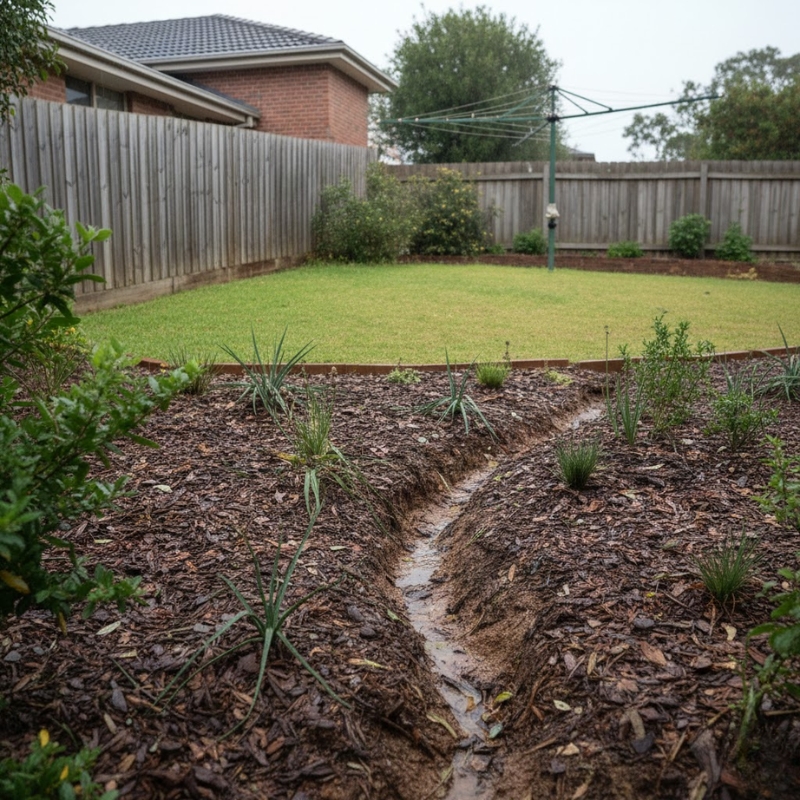
4) Soil washing away and leaving channels after rain
Erosion is a slope’s slow “death by a thousand cuts.”
Red flags include:
• Narrow channels (rills) forming down the slope
• Exposed roots or exposed irrigation lines
• Mulch migrating downhill into piles
• Sediment collecting in paths, paving gaps, or at the base of steps
Even mild erosion matters because it removes support, steepens the slope in spots, and can undercut garden structures.
5) Pooling water where it never pooled before
A slope that suddenly holds water is telling you something has changed.
Common causes:
• Blocked stormwater outlets
• Compacted soil (water can’t soak in)
• Settling that creates a shallow “dish”
• Runoff from a new driveway, roof downpipe, or neighbour’s hardscape
Pooling near the top of a slope is especially risky because it increases saturation and weight in the most influential zone.
6) Cracks in paving, pavers separating, or steps shifting
Hard surfaces are great at revealing movement.
Watch for:
• Pavers that separate into new gaps
• A step that feels “taller” or uneven
• Concrete that develops new hairline cracks that grow
• Retaining edges that no longer sit flush
Even if the slope movement is small, hardscaping can turn it into a trip hazard fast.
7) A wall or garden edge leaning, bowing, or “opening up” at joints
Not every wall issue is slope instability, but slope instability often shows up here first.
Signs include:
• A wall face that leans outward (even slightly)
• Sections that bow in the middle
• Gaps opening at joints
• Drainage outlets (weep holes) that are blocked or constantly wet/muddy
If you’re noticing these symptoms, it’s worth understanding what good drainage and support should look like. For a practical overview of components that matter (especially drainage), see this retaining wall construction guide.
8) Sudden changes after a storm: “It looks different this week”
Pay attention to “new” after heavy rain.
Typical post-storm instability clues:
• Fresh slumps of soil near the mid-slope
• New sediment fans at the bottom
• Turf that feels spongy underfoot
• A previously firm path turning soft or shifting
If your slope looks different after rain, treat it as a prompt to do a focused inspection (there’s a checklist below).
9) Doors, windows, or nearby structures behaving oddly (near-slope homes)
If your slope sits close to your home, garage, driveway, or pool area, structural symptoms matter.
Look for:
• New cracks in external brickwork
• Windows/doors sticking
• New gaps at skirting boards inside
• Driveway edges sinking or separating
These don’t always mean slope failure, but they’re serious enough to warrant professional assessment—especially if they’re new and progressing.
Q&A: Is it erosion or subsidence (and does it matter)?
Erosion is soil being carried away by water, usually visible as channels or exposed areas. Subsidence is soil sinking due to loss of support underneath (washout, poor compaction, leaking water). Both matter because both reduce stability. If you can see channels and sediment movement, erosion is likely. If an area sinks without obvious channels, subsidence or washout is more likely. Either way, managing water is the first priority.
Why slope problems often come down to water (not “bad soil”)
Soil type matters, but water is the accelerant.
When soil gets saturated:
• It becomes heavier (more load on the slope)
• It loses shear strength (it “sticks together” less)
• It can build pressure behind garden edges and walls
• It can scour channels that remove support
In practical terms, the most common backyard triggers are:
• Downpipes discharging onto a slope
• Poor surface grading (water running where it shouldn’t)
• Blocked subsoil drains or no subsoil drainage at all
• Overwatering garden beds at the top of a slope
• New landscaping that adds load close to the edge (soil, rocks, planters)
A Sydney-focused post-rain slope inspection checklist
Do this the day after heavy rain, when it’s safe to walk the area.
Step 1: Start at the top of the slope
• Check if downpipes overflowed or discharged onto soil
• Look for pooling near the crest
• Check for fresh cracks running across the slope
• Look for “soft” ground that feels spongy
Step 2: Scan the face of the slope
• Look for new channels or exposed roots
• Check for slumping (a small section that looks like it slid)
• Look for bulges or ripples in turf/mulch
• Note any areas where mulch has migrated
Step 3: Check the bottom and any garden edges or walls
• Look for sediment build-up (a sign soil moved)
• Check if edges or walls are leaning/bowing
• Make sure outlets and drains aren’t blocked
• Note persistent wet patches (a sign water is trapped)
Step 4: Document and measure
• Take photos from the same spots each time
• Use a ruler for crack width
• Use a string line or straight timber to check wall bowing
• Keep a simple log: date, what changed, and what the weather was
What you can safely do right away (and what to avoid)
Low-risk actions that help immediately
• Redirect downpipe discharge into appropriate stormwater where possible (temporary extensions can help while you plan)
• Clear visible debris from surface drains and outlets
• Reduce watering at the top of the slope
• Keep heavy items back from the crest (pavers, rocks, soil piles, large planters)
• Patch bare soil with groundcover, mulch, and erosion control matting (where appropriate)
• Create temporary diversion (a shallow swale) to stop water cutting straight down a channel
What to avoid (common DIY mistakes)
• Don’t excavate into the slope face “to tidy it up” if you’re seeing movement
• Don’t add extra soil to the top to “level it out” without a plan—more weight can worsen movement
• Don’t block drainage outlets because they look messy
• Don’t rely on thin edging or shallow posts to restrain soil that’s already pushing
If you’re unsure what “right” looks like for stabilising and supporting garden levels, a tailored plan matters more than a quick patch. For homeowners looking for options that suit the site, this overview of retaining wall solutions can help you understand the direction of travel (without guessing).
When to treat it as urgent
Escalate quickly if any of the following are true:
• Movement is sudden (days, not months)
• Cracks are widening rapidly
• A wall is visibly leaning/bowing and getting worse
• Water is trapped behind a wall/edge and can’t escape
• The slope is close to a building, driveway, pool, or boundary fence
• You can see active soil slumping after rain
• You’re worried runoff is impacting a neighbour
In these cases, professional assessment can help you avoid secondary damage (like broken stormwater, damaged fences, or undermined paving).
Q&A: Do I need approval in NSW for earthworks or a retaining structure?
Sometimes. In NSW, whether something is exempt, complying, or needs a development application can depend on details like height, location, load, proximity to boundaries, and what it’s supporting. A good starting point is the NSW Planning Portal guidance on earthworks and retaining structures, which outlines common approval pathways and considerations: NSW Planning Portal – Earthworks, retaining walls and structural supports.
Practical scenarios Sydney homeowners run into
Scenario 1: “My fence is leaning after storms, but the garden looks fine”
Often the ground around posts has softened or shifted first. Treat the fence as an indicator, not the whole problem.
Do:
• Check drainage and water flow along the fence line
• Look for soft ground or small cracks near posts
• Photograph the lean and monitor weekly
Scenario 2: “Mulch keeps sliding downhill and I’m getting channels”
That’s active erosion. Fixing it is less about “more mulch” and more about controlling water and stabilising the surface.
Do:
• Break the flow path (small swales, step-down terraces, groundcover)
• Address runoff sources (downpipes, hardscape runoff)
• Reinforce channels short-term with erosion control matting
Scenario 3: “The wall looks like it’s pushing out a little”
Even small bowing can mean water pressure is building behind it or the base is compromised.
Do:
• Check drainage outlets for blockage
• Look for constant wetness or muddy seepage
• Get it assessed before it becomes a safety issue
Scenario 4: “The slope sits near the driveway and pavers are separating”
This can be more than garden movement—it can become access and structural risk.
Do:
• Stop adding load near the driveway edge
• Check for water flow under paving
• Seek advice sooner rather than later
If you need a next step that’s grounded in your specific site—levels, drainage, access, and what the slope is supporting—this is the point where getting help with a sloped garden becomes the sensible move (before small movement becomes major rework).
How professionals typically approach a moving slope (so you know what to expect)
Without turning this into a “service page,” it helps to understand the usual logic:
• Identify water sources and pathways (surface and subsoil)
• Reduce saturation and pressure with drainage
• Regrade or terrace to reduce steepness where possible
• Add engineered support where needed
• Stabilise surfaces with planting and erosion control
• Protect boundaries and manage runoff responsibly
The best solutions are always site-led. Two slopes that look similar can behave very differently depending on soil, drainage, and what’s above and below them.
FAQ
How long does it take for a slope problem to show up?
Often months or years—until a wet season or a big storm reveals it. The key is whether the signs are new and progressing.
Are cracks in the yard always a bad sign?
Not always. Dry-weather cracking can be normal. Cracks that appear after rain, form curved lines across a slope, or keep widening are more concerning.
Can plants stabilise a slope on their own?
Plants help with surface stability and erosion control, but they won’t fix deeper movement caused by poor drainage, saturation, or inadequate support.
What’s the most common cause of slope movement in backyards?
Water management problems—runoff and trapped moisture—combined with added loads near the crest (soil, rocks, planters) or inadequate support.
Should I stop watering if I think my slope is moving?
Reduce watering at the top of the slope and avoid soaking garden beds near edges until you’ve addressed drainage. Don’t let plants die, but avoid excess.
What’s the danger of “just ignoring it”?
Small movement can undermine paving, fences, and stormwater systems. Over time it can become a much bigger repair—especially if boundaries and structures are involved.